
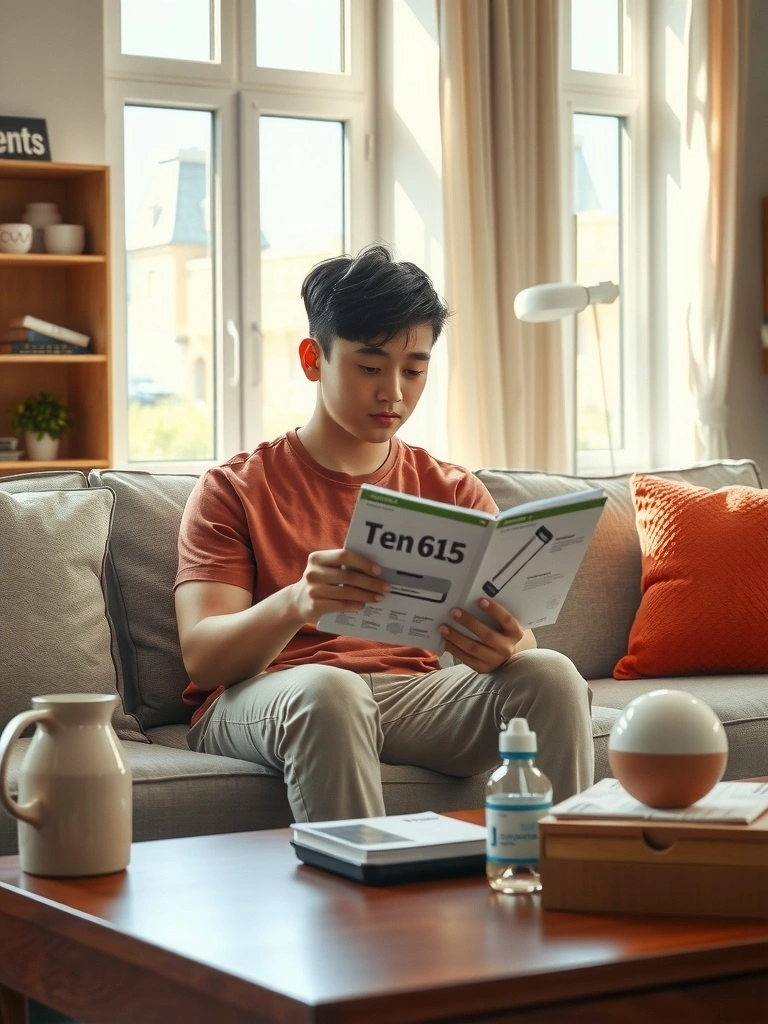
In the hustle and bustle of modern life, the younger generation has a more nuanced and personalized pursuit of the definition of "home." This change has subtly influenced the rhythm of the home goods market. With an increasing number of renters and first-time homebuyers, many young consumers are becoming "newbies," independently assessing their living needs in their own living rooms for the first time. Every small item's selection embodies considerations of quality, practicality, and future lifestyle choices. A warm and modern living room becomes the stage for this "unboxing" experience, where a determined young novice sits on the sofa, intently reading the instructions for home goods, surrounded by an atmosphere that is both fresh and full of hope.
Outside, the sunlight is just right, filtering through large floor-to-ceiling windows, casting a soft golden glow into every corner of the room. The wooden floor enhances the warmth, while light-colored cushions on the sofa offer both style and comfort. On a spacious coffee table lies a collection of newly purchased home items, including a smart mini rice cooker, a small air purifier, a multifunctional remote control socket, a wireless Bluetooth speaker, a desktop USB charging station, an ultra-fine microfiber mop, a collapsible storage box, and a set of minimalistic scented candles. The tabletop is arranged in an orderly manner, exuding a sense of ritual.
This young novice is undergoing a familiar yet often simplified "home upgrade" first experience. Traditionally, buying home goods seems merely like the process of acquiring "tools," but for modern young consumers, it’s not just about choosing a product; it feels more like a meticulous refinement of their lifestyle. Every step and detail are infused with their expectations for future living quality and their imagination of "home."
He first picks up the multifunctional remote control socket to read the manual. Although it's his first foray into independent living, young people often possess enough technological sensitivity. The convenience that smart appliances bring piques his interest greatly. Looking at the manual, which clearly outlines the button steps and installation process, he compares the differences in the product’s features while consulting online reviews to find objective data and real user experiences. This shift from formulaic shopping to actively participating in product evaluation reflects several key characteristics of the new generation's consumer behavior—valuing information transparency, pursuing personalized choices, emphasizing practical efficiency, and being willing to repeatedly compare to accumulate life experiences.
Various small home items quickly enter his testing list. For instance, that small air purifier occupies little space and has a simple appearance. He unboxes it and carefully inspects the filter design and control panel. For young people, who are highly sensitive to common urban air pollution, whether the air purifier is quiet, how easy it is to change the filter, and its connectivity with a mobile app are all key points on the evaluation list. He records the operational noise level while trying out remote control via his phone and even makes bold suggestions for improvements based on whether it has features like a timer or smart detection. This entire process is not just a simple "unboxing experience"; it's a deep experiment and contemplation.
The collapsible storage box is one of his most satisfying selections. Many young people live in small spaces; therefore, whether the storage system can be quickly assembled, easily moved, and is durable and dustproof or waterproof are indicators of particular concern for him. He disassembles and reassembles the storage box, testing its weight capacity with various household items while imagining using it freely on the balcony, in the garage, or in storage rooms in the future. As he meticulously reads through the instructions, he feels a bit nervous but experiences a sense of achievement upon completion. A small item can lead to a new management perspective on home chores.
The wireless Bluetooth speaker with smart voice features brings surprises for upgrading the living room. Streaming his favorite music from his phone or using voice commands to adjust tracks and volume adds a touch of technological fun for future gatherings with friends. He doesn’t rush to complete all settings at once; instead, he consults customer service multiple times and views online videos to ensure that every function can be optimized. This self-directed learning approach represents modern young consumers' proactive grasp of knowledge and emphasis on autonomous learning.
Notably, the ultra-fine microfiber mop on the table changes the perception of cleaning chores. Once seen as tedious, well-designed and easy-to-use cleaning tools now play a key role in freeing up hands. He carefully reads how to install the mop head, change the cotton head, and clean and maintain it, all to quickly restore the cleanliness and brightness of the coffee table. This is not just a breakthrough in product functionality but also enhances home quality—reducing chore stress, improving cleanliness, and subsequently increasing family activity opportunities.
Throughout the process of operating the home goods manual, a spirit of exploration regarding the unknown is gradually revealed. The young demographic entering home life is not afraid of "the thickness of the manual"; they even enjoy engaging in every step of unpackaging, installation, and testing. In this self-training process, he learns not only how to simplify procedures and how to reasonably arrange the positioning of each item but also actively converts existing experiences into valuable references for future purchases. Whether it's an air purifier, a set of scented candles, a multi-functional desktop charging station, or a remote control socket, these items are woven into daily life and, in turn, define personal standards for taste, efficiency, and reassurance.
Interestingly, this young novice even drafted a "home goods self-evaluation form," detailing every installation, operation, and maintenance step—including power consumption, practical frequency, user-friendliness, ease of repair, and aesthetic appeal—gradually compiling them into charts as a basis for future purchases or recommendations to friends. Such actions, though carrying a hint of an engineer's spirit, also reflect the rational beauty of modern life.
As the sun moves, the living room transitions from morning light to afternoon warmth, and this new homeowner's "home goods evaluation" journey is coming to an end. Through hands-on involvement, he gains a clear understanding of the gap between his expectations for products and actual usage, evolving from ignorance and curiosity to proficiency. All experiences transform into a new landscape of personalized living. Home is not just a space to shield from the elements; it is a small experimental ground for achieving self-management, aesthetic choices, technological applications, and future planning—each piece of household gear serves as a key to this journey.
Looking at the broader picture, the home goods market is thriving, and the demands of young novices are driving continuous updates in design and functionality. Experts observe that with the proliferation of smart home appliances, consumers are establishing a closed-loop ecosystem between "selection—learning—experience—feedback." Each product must withstand the scrutiny and word of mouth of the information age. In the future, more home items that integrate artificial intelligence, modular design, and minimal aesthetics will emerge, shifting home scenarios from traditional "passive use" to "active management," with the younger generation gradually becoming the core driving force of this revolution.
With fresh and bright sunlight filling the space, the novice puts away the instruction manual and smiles with satisfaction. Home is no longer solely about instinctual choices; it is a deep dialogue between rationality and emotion. From this moment on, being the "home manager" is not just a slogan, but a concrete practice of an emerging lifestyle—each instruction manual, each product, and each evaluation intertwines modern aesthetics with efficiency. This journey has just begun, and the chapters of home living for the new generation await more explorers to write their exciting stories.