
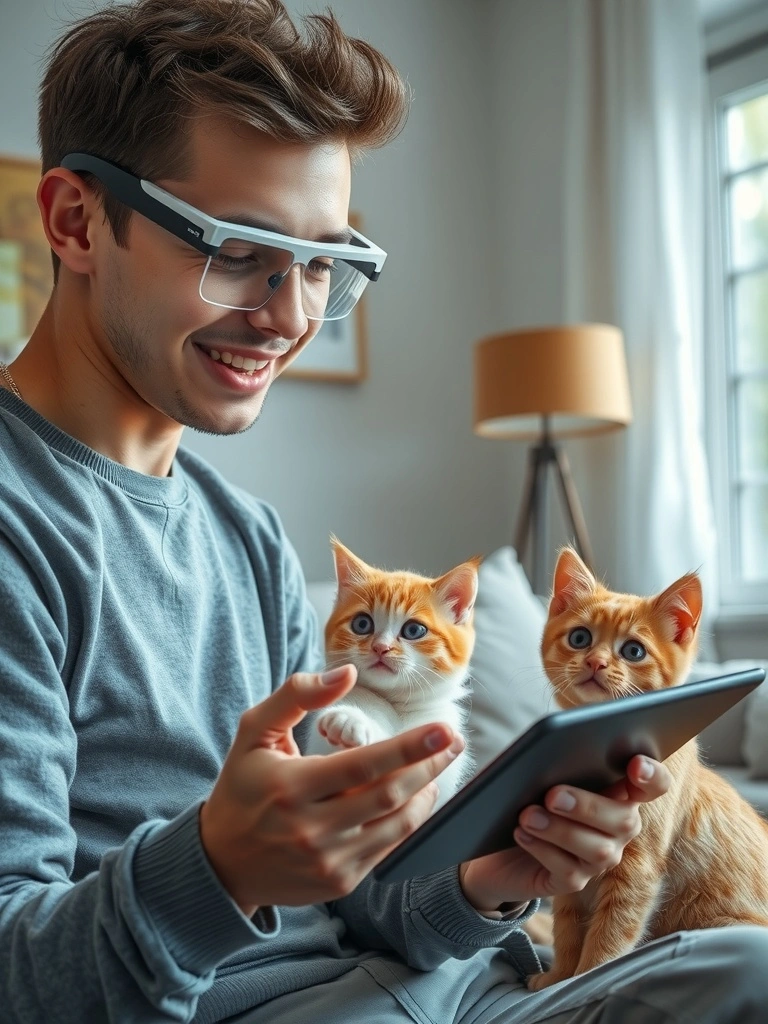
Whenever technology intertwines with warmth, it always stirs up unusual stories in our daily lives. One afternoon, in a bright modern living room, the eye is drawn not just to the sleek marble floor and the minimalist wooden cabinets, but also to a young man wearing the latest tech glasses, sitting comfortably in a corner of the sofa, fully immersed in his own world. His focus is not on a TV series, but rather on a tablet that is as thin as paper in his hands. What draws attention are the two fluffy figures nearby—a round-faced cat with big eyes and an energetic Shiba Inu wagging its tail. Is this the daily life of a tech enthusiast, or the beginning of a revolutionary interaction between humans and pets in the future?
The protagonist of this day—the young technology fan—is activating the latest smart enhancement device for his pets. He secretly named this system "Pet Pixie Smart Butler" and firmly believes it is not just a machine, but something that will establish a brand new understanding between humans and animals.
Morning light shines on the tech-blue frames of the glasses, reflecting a complex dynamic interface on the lenses. The latest generation of augmented reality glasses can instantly display information about indoor objects, analyze environmental temperatures, and monitor pet behavior data. The young man lightly taps his temple with his index finger, calling forth a virtual menu—the voice command smoothly integrates: "Xiaoxue, jump, come play interactive training now."
Accompanied by the voice, the tablet screen immediately transitions. Two cartoon avatars representing the cat and dog appear, each thoughtfully labeled with health status, mood indicators, and energy levels. The young man taps one of the buttons, causing a cylindrical white device in the corner of the room to start vibrating gently. This smart enhancement device not only provides automatic feeding and interactive toy functions but also intelligently allocates interaction plans based on the pets' varying emotions and needs, as well as the current level of the owner's busyness.
Xiaoxue the cat, originally lazily stepping by the edge of the bed, lets out an unhappy "meow" upon seeing the automatic cat teaser spring to life, yet cannot resist being drawn to the flashing lights and playfully pounces at it. The Shiba Inu, wagging its tail and sparkling with impatience, dashes towards the small ball ejected from the machine, catching it in its mouth. The young man cannot help but chuckle: "Today's physical training is a bit like a pet version of a fitness coach."
A closer observation of this new milestone in human-pet interaction reveals that technology has redefined companionship. Unlike traditional feeding or playing with pets, today's smart enhancement devices combine data analysis and behavioral psychology to design tailored interactions based on the pet's breed, age, and past behavior records. The device has multiple built-in sensors: infrared sensors can instantly detect the movement trajectories of cats and dogs; heart rate monitors accurately gauge their excitement and fatigue levels. Every minute of jumping creates cloud data that analyzes their health curves and happiness indexes.
Experts analyzing future trends point out that with urban life becoming increasingly busy, the "smart pet butler" not only addresses the challenges of insufficient companionship time but also allows pet owners to keep track of their furry friends' health at any time. The system will push dietary recommendations, veterinary reminders based on collected data, and even automatically adjust heating and cooling temperatures according to the weather. A well-known pet behavior expert interviewed stated that more and more devices can "read" animal expressions and barks, predicting their emotions and needs, and potentially providing early warnings of diseases or stressors in the future, ensuring that every cat and dog is cared for like a family member.
Returning to the scene, the interactive game on the smart tablet had progressed to the third round. The male protagonist humorously activated the augmented reality mode—suddenly, colorful little fish, butterflies, and spheres appeared all over the room, visible only to him wearing the glasses. However, the cat and dog dutifully chased after the toys that were genuinely released, as if entering a fantastical world belonging solely to humans and their pets. At this moment, the air is filled not only with the rationality of high technology but also with the warmth and authenticity of life.
This smart enhancement device can also be set to function remotely. For instance, if the young man needs to go to work during the day, he can control the device through a mobile app to activate fun automatic cat teases, treat times, or switch to soothing music modes. The push notification feature will instantaneously return images and data from home, allowing the owner's yearning to transform into observable companionship.
Surprisingly, the device can also store historical records, creating a "pet life journal." Each mischievous moment when the cat pushes a cup off the table or the dog learns a new trick becomes part of a cloud album. In the quiet of the night, the young man flips through these records, unable to hold back a smile: "What unbelievable mischief did you get into today?" Touching daily moments, made more vivid and lively through the aid of technology.
Data from the market shows that sales of related products have been steadily growing over the past year, with the primary consumer group being young tech enthusiasts and working professionals. Expert reports further indicate that with the introduction of big data and artificial intelligence concepts, smart enhancement devices have gradually evolved from single toys into comprehensive caregiving systems, addressing diet, health, and psychology— "one device in hand for all-round care." Many consumers emotionally express, "Rather than saying it's a machine, it's more like a third companion that understands love."
Observing this protagonist's interaction with his pets—a candid and straightforward man who sometimes softly comforts the cat sharpening its claws and other times engages in a playful chase with the Shiba Inu—each laughter serves as a silent testament to technology's role in life. Some question whether this will diminish the natural intimacy between pets and their owners, but evidence shows that smart technology actually creates more shared time. Busy modern individuals can effectively utilize "human-machine coordination," allowing technology to partner with warmth, creating a more perfect home.
Exploring the core technology of this smart enhancement device, the software development team notes: "In our early design phase, we spent a lot of time observing pet movement and communication. Every small detail, such as the frequency of a dog's tail wagging or the direction of a cat's ear movement, is critical for interpreting behaviors in the program. On the hardware side, we optimized the stability of the machine, ensuring the device operates smoothly on both quartz floors and thick carpets, providing safety and durability in different home settings."
Furthermore, user experience is a key area for ongoing improvement by the team. The device's sound is not overly jarring, and its mechanical movement speed adjusts automatically based on the pet's familiarity and age. Naturally, what users praise most is its "learning AI personality"—each device evolves different interactive modes based on the pet's character, some gentle, others playful, and some resembling strict coaches, reminding them when to exercise and eat.
Today, more and more families treat their pets like children, making technology a new medium for this intimate relationship. In the past, after a tiring day at work, one could only weakly accompany their furry friends, but now, with simple tablet operations, a series of rich interaction combinations can be initiated. This is not merely collaboration between humans and machines; it represents a redefinition of "home"—allowing technology to become part of life aesthetics and making companionship possible.
During his on-site interview, this young technology enthusiast stated: "For me, the best thing about this device is that it truly understands our cat and dog. Sometimes it observes them more meticulously and thoughtfully than I do. Coming home every day to see them happily chasing after the machine brings me joy and releases my stress. Even interacting remotely through the screen allows me to experience an unprecedented sense of companionship, warmth, and trust."
Technology and life, in a cozy corner of the living room, have penned another blueprint for contemporary happiness. From smart pet food dispensers to interaction games designed around emotions, every step of innovation makes the promise of "growing up together" no longer difficult or unreachable. A promising future awaits; as the spring breeze of smart homes enters every household, the relationship between "pets and people" will continue to evolve with the aid of technology. This warm yet avant-garde fingertip interaction may very well be the most sincere tribute to "home" in the new era.