
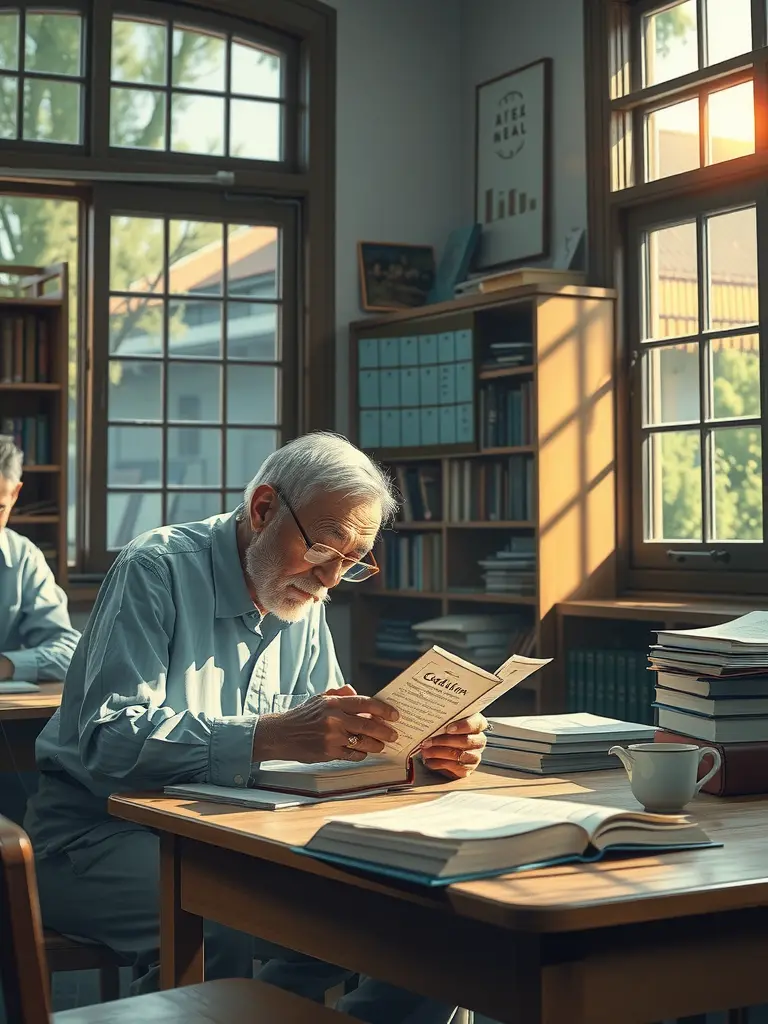
The afternoon sunlight gently filters through the floor-to-ceiling windows of the classroom, casting soft rays on the neatly arranged rows of long tables. The space is imbued with a light scent of books and ink. In such an elegant atmosphere, a group of spirited seniors is intently flipping through thick educational case studies. Their faces are focused and gentle, with eyes reflecting a thirst for knowledge and respect. Every corner of the classroom is filled with the enthusiasm for learning and the brilliance of wisdom.
This classroom is not a serious or remote place as one might imagine, but rather resembles a small academy full of warmth and vitality. The beige walls are adorned with various teaching charts and handwritten notes by the seniors. The chandelier above casts a soft glow, creating a cozy and focused atmosphere in the space. Here, learning is no longer a privilege of the young or children; the passage of time has not diminished these seniors' curiosity about the world. Instead, having entered a new phase of life, their desire for knowledge becomes more profound and pure.
In the center of the classroom, in front of a specially crafted wooden table, several seniors are carefully studying a hefty resource called "Classic Educational Case Studies," which not only covers timeless educational philosophies but also records numerous vivid cases that have occurred in educational settings over the past few decades. These cases are meticulously compiled by professional teachers and education scholars, perfectly blending practical experience with theoretical knowledge, becoming an invaluable treasury for learning and exchange.
Upon closer inspection of the table, almost every senior has a thick learning checklist in front of them. These checklists are carefully crafted according to individual needs and encompass various content, including classic course study, educational reflection discussions, personal insights, and group experience sharing. Each time they complete a task, the seniors diligently mark it on the checklist, and a subtle sense of accomplishment glimmers in their expressions, adding a richer hue to their originally passionate learning time.
The classroom's proceedings are quite different from traditional teaching methods. The instructor does not preach from a high pedestal, but rather acts as a guide and collaborator, assisting seniors in exploring the deeper meanings behind each educational case. Today's lesson focuses on "The Changes and Reflections of Intergenerational Education." The instructor softly steers the topic from the earliest oral traditions to today’s digital distance learning. The seniors express their viewpoints and share their own teaching or learning experiences. Some discuss the conveniences and confusions of information technology, while others lament the limitations and purity of early educational resources. Through mutual inspiration and exchange, knowledge and experiences flow like a gentle stream, gradually merging into a river, allowing every participant to draw strength and inspiration from it.
It is worth mentioning that this education case repository includes numerous cases that seniors themselves have participated in. For instance, a student in his seventies shared how he once initiated a literacy class in a community, helping more of his peers escape the plight of illiteracy. He reminisced about how he used the simplest blackboards and chalk, employing local stories as teaching materials, and how he progressively designed lesson plans and activities to help others grasp reading and writing skills from simple to complex. Such experiences, interwoven with formal educational theories, not only make the repository more relatable and contemporary but also evoke strong resonance among other learners during the reading process.
Moreover, the display cabinet in the corner of the classroom showcases learning成果 and record books accumulated over the past few years. This includes educational reflection diaries handwritten by seniors, solutions generated after group brainstorming sessions, and various illustrated compilations of learning achievements. These precious historical testimonies not only present the progress trajectories of the learners but also hold symbolic significance—learning is not a privilege of a certain stage but a life journey that can be passed down, deepened, and developed by one generation after another.
In addition to theoretical and experiential discussions, the class also designs various types of group activities. For example, this afternoon's group discussion focuses on the topic of "Teaching Challenges and Coping Strategies." Before class, the instructor distributed a robust educational dilemma case handbook to each group, asking members to combine their experiences and propose at least three innovative solutions. The discussion atmosphere is lively, as the seniors draw from their past observations in teaching, with some suggesting leveraging social media to bridge the gap between teachers and students, others advocating for redesigned reading materials to cater to different age needs, and some championing the balanced use of traditional recitation and modern phonetics. Whenever an innovative proposal is born, members generously affirm and discuss it, while the instructor provides timely guidance and inspiration. In the end, each group produced its own teaching improvement proposal and presented it at the whiteboard, with other members offering feedback to refine their thoughts further.
Adding to the enriching atmosphere is the seniors' remarkable drive for learning and collaboration beyond their years. Many brought homemade lunches to share during breaks, where they bonded not just over knowledge but also shared bits of life. Some pulled out yellowed notebooks to discuss warm moments from a graduation ceremony, while others enthusiastically recommended a recently popular reading app, inviting peers to explore digital tools together. This cross-temporal and age-defying exchange of knowledge continues to occur in this cozy classroom, in the most natural and heartwarming ways.
It should not be overlooked that this classroom has intentionally adopted the design concept of a "learning organization," emphasizing communal learning and collective growth. Every morning and before classes end, the instructor arranges a "mood segment," allowing learners to share their greatest gains or confusions of the day in small groups. This effectively prompts seniors to examine their learning status and seek assistance when needed. Simultaneously, this interaction fosters a more cohesive atmosphere in the class, where everyone encourages and embraces imperfections, further nurturing a positive attitude toward lifelong learning.
To a senior deeply involved in community education promotion, the changes brought about by this classroom have far exceeded initial expectations. He stated that although he has long ended his professional career, the continuous learning and exchanges over the past few years have made him feel like he has returned to his youthful days. Through reading educational case studies, he constantly absorbs new knowledge, re-examines the changes in teaching settings, and even applies the methods he has learned in volunteer services and family education, significantly improving the learning motivation and outcomes of several family members and partners. He emphasized that when everything was at one’s fingertips in youth, looking back now makes one more aware of the importance of knowledge and the preciousness of learning.
Experts and educational researchers highly value such senior-centric continuing education courses. They point out that no matter how rapidly the world changes, the pursuit of knowledge and discussions about educational issues should not be limited by age. Furthermore, this case-based teaching method not only enhances seniors’ enthusiasm for autonomous learning but also broadens their perspectives. Since the cases cover different historical stages and cultural backgrounds, it allows learners to transcend mere personal experience and reflect on the essence of education and its future development from a broader perspective.
As the afternoon class approaches its end, the sunlight's slanted shadows cast from the windows gradually lengthen, while the classroom maintains an atmosphere of quiet and focused learning. Some are independently reviewing their learning checklists, assessing their progress for the day; others are discussing contentious points from the case with peers, preparing to read the relevant materials again; while some confidently jot down insights in their notebooks, looking forward to deeper explorations next time. Outside the classroom, the service team has thoughtfully prepared snacks and tea for learners to enjoy, making learning not just a cognitive process but also a delightful part of life.
The chirping of birds and the swaying of tree shadows outside gently contrast with the knowledge and vitality inside the classroom. This warm learning space offers seniors not just rich educational cases but also profound reflections on their life journeys. As the light of knowledge penetrates the sediment of time, this group of seniors is continuing on their own learning paths with the most sincere attitudes and steadfast steps. Through their stories and actions, they illustrate the essence of learning—it knows no age and is not confined by time; only through continuous learning can life truly blossom. Such a scene is both heartwarming and moving, deeply inspiring admiration for their resilient spirit of learning.