
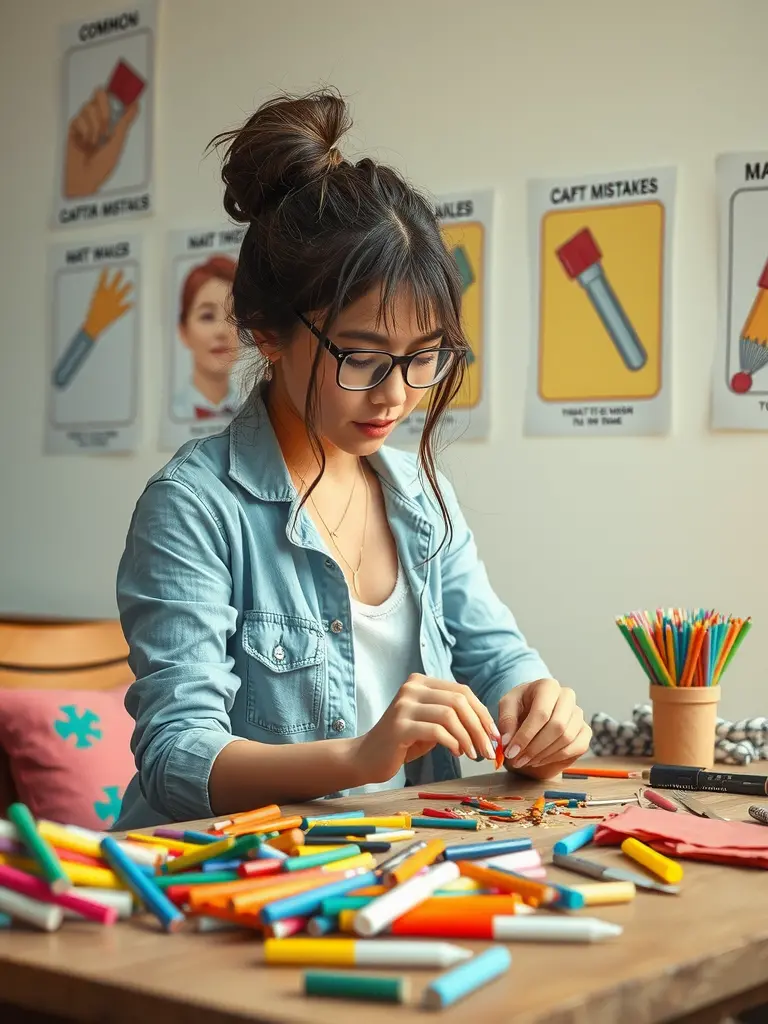
Sunlight streams through the floor-to-ceiling windows onto the wooden floor, creating a warm and vibrant atmosphere in the classroom. In the handmade workshop at nine o'clock in the morning, participants of various ages gradually take their seats. The tables and chairs are neatly arranged, and colorful tablecloths are spread across the surfaces. The most eye-catching figure in the room today is a young woman sitting at the front. She wears fashionable casual attire that is simple yet stylish, a white T-shirt paired with denim jeans, with cleverly hidden accessories—golden thin bangles and a high-quality canvas bag—complementing her neatly tied short hair. The bright and soft light illuminates her focused profile, showing an expression full of anticipation for the upcoming handcrafted creation.
This is a workshop themed around promoting creative crafts, where all sorts of materials are already prepared on the work tables. Colorful yarn, bright beads, soft blocks of clay, vibrant fabrics, and professional carving tools are arranged in an orderly fashion. Everywhere the eyes can see, there are elements that inspire participants to explore the infinite possibilities contained within.
The young woman slightly bows her head, immersing herself in the world of materials. Her movements are fluid as she first uses a finely detailed pair of scissors to trim the edges of the fabric pieces, then skillfully takes up needle and thread to sew them together meticulously. Occasionally, she pauses to examine her work or flip through crafting templates provided nearby. While others observe intently, she remains calm and relaxed, softly humming a little tune. There is no trace of impatience; she seems to merge with the process of crafting, focused and tranquil.
Interestingly, a series of posters titled "Common Misconceptions in Crafting" are specially displayed on the classroom's background wall, making it a highlight of the space. Many beginners mistakenly believe that crafting only involves simple assembling, while it actually conceals numerous details and pitfalls. The posters use lively illustrations to humorously outline common mistakes: some bead strings aren’t aligned, resulting in crooked finished products; some sewing has exposed threads, making the work appear careless. One particularly notable poster depicts a cartoon of “too many folds in handmade items, making them look like crumpled paper,” prompting many people on-site to smile knowingly and reminding everyone to maintain a careful and patient attitude towards their craft.
In fact, what appears to be an easy skill in crafting is filled with many details and knowledge. Professional instructors point out that whether it's hand sewing, clay shaping, or jewelry stringing, every step requires time, experience, and precision judgment. Beginners often encounter various minor setbacks in the "learning by doing" process. The most typical problems stem from improper material choices, wrong tool selections, or insufficient understanding of the basic structure of crafting, leading to unsatisfactory results. These "misconceptions" are precisely the reason why they are deliberately displayed on the classroom wall, hoping that students not only learn crafting but also avoid unnecessary detours.
During the interview, multiple participants expressed strong interest in the poster wall. "Whenever I encounter a problem, I actually come over to see if I’ve made any of these common mistakes. Seeing the humorous illustrations is sometimes a relief from my anxiety; it makes me realize learning is about allowing space for error," one participant shared her experience. This approach of conveying professional knowledge to beginners in a light-hearted manner is both specific and considerate, effectively providing higher learning motivation.
In the crafting workshop, that young woman is gradually showcasing her craft. She deftly folds a turquoise fabric and stitches it together with tiny stitches, skillfully embedding a bright yellow ribbon, adding a lively splash of color to her work. Beside her, a cup of aromatic latte rests; she occasionally looks up to take a sip, yet her hands never cease their work. The other participants occasionally ask her for details—“How do you attach the fabric here?” “What should I do if my stitches go awry?” She patiently explains and even demonstrates how to untie and repair.
A seasoned instructor observed and remarked that focus is one of the most important traits of a crafter. "Nowadays, many people lead busy lives and rarely have the opportunity to fully concentrate on one thing. The crafting process requires undivided attention to create intricate works. Seeing young participants so focused, I feel this is where the beauty of crafting lies," the instructor said slowly. "Crafting is essentially a process of dialogue with oneself, from nothing to something; every stitch encapsulates the emotions and expectations of the creator."
Stepping into the crafting classroom, the air is filled with the natural scent of materials, a combination of the delicate aroma of fabrics and the warmth of wooden tools. The pile of colorful materials on the table is a delightful surprise for beginners and an endless source of creativity for advanced crafters. Many participants share that "fabric pairing" is the most challenging part for them, with some sorting by color and others preferring to clash colors. The classroom has also established a "Materials Experimentation Area," where participants can try different elements on-site, encouraging everyone to break traditional frameworks and spark more creative ideas.
As for the crafting process, from selecting materials to completing the work, every link needs careful consideration. The young woman demonstrated the classic five-step process of "Choosing Materials—Designing—Cutting—Sewing—Decorating," first sketching her ideas in a notebook, measuring every curve and color block's position. After receiving guidance, she tried various sewing techniques, including hidden stitching and surface decorative sewing. These technical details are often the key points that many beginners overlook and validate the existence of the misconception posters. For example, one common mistake is "Overly pulling the thread," which leads to fabric distortion and uncoordinated wrinkles in the finished piece. The professional instructor emphasized that gestures should be gentle and movements smooth, with restrained force to ensure a neat and delicate finished product.
At the completion stage, participants add personalized elements to their work according to their preferences, such as stitching their initials, adding cute patches, or tying luxurious ribbons. This is the most lively part of the class, with everyone comparing and encouraging one another. The young woman enthusiastically showcases her finished piece to her peers, beaming with a confident smile. Her work combines practicality with aesthetics, exhibiting high artistry in its detailed handling and color coordination, earning admiration from her peers.
The crafting classroom encourages "learning and sharing in parallel." Before the end of each class, there’s a "Results Sharing Session." Students form small circles to take turns presenting their work and discussing their creative concepts and challenges faced during the process. This part is extremely popular among participants, as it not only helps them learn from each other but also sparks more inspiration. Some participants unexpectedly discover unprecedented combinations during discussions, while the professional instructor addresses students' questions, explaining how to avoid common misconceptions on-site, closely intertwining theoretical knowledge with practical operations.
The misconception posters on the classroom wall have gradually become a spiritual symbol here. They serve not only as humorous reminders but also as a gentle companion for creators on their learning journey. Behind each misconception lies a story of retrying after failure. Seasoned instructors encourage students to embrace "making mistakes" because misconceptions are a necessary part of creative growth. "We hope that everyone who comes here to learn crafting will bring passion and courage, unafraid of mistakes and eager to share, constantly making progress."
It is worth mentioning that as the interest communities for crafting grow on social media, more and more young people are willing to invest in handmade creation. The crafting classroom warmly welcomes students with zero experience; as long as there is interest and an open mindset, even if they encounter misconceptions at the start, with the support of professional instructors and enthusiastic students, they can gradually overcome learning barriers and find their sense of accomplishment.
After completing a morning class, the young woman steps out the door with a handmade product and a bright smile. Under the bright light, her silhouette together with the colorful and creative crafting classroom seems to write a wonderful chapter for the day. Those colorful materials, her confident focus, and the warm and humorous reminders of misconceptions on the wall represent the most unique landscape of this creative space and are an incredibly precious slow-living moment in many people's lives.
In the future, such crafting experience classrooms will continue to be a popular choice for urban dwellers to relieve stress, explore creativity, and enhance the beauty of life. Whether beginners or experienced crafters, as long as they are willing to get hands-on, pairs of focused eyes and delicate hands can weave their own beautiful stories. Each work and each experience from failure to success quietly unfold in this bright classroom.