
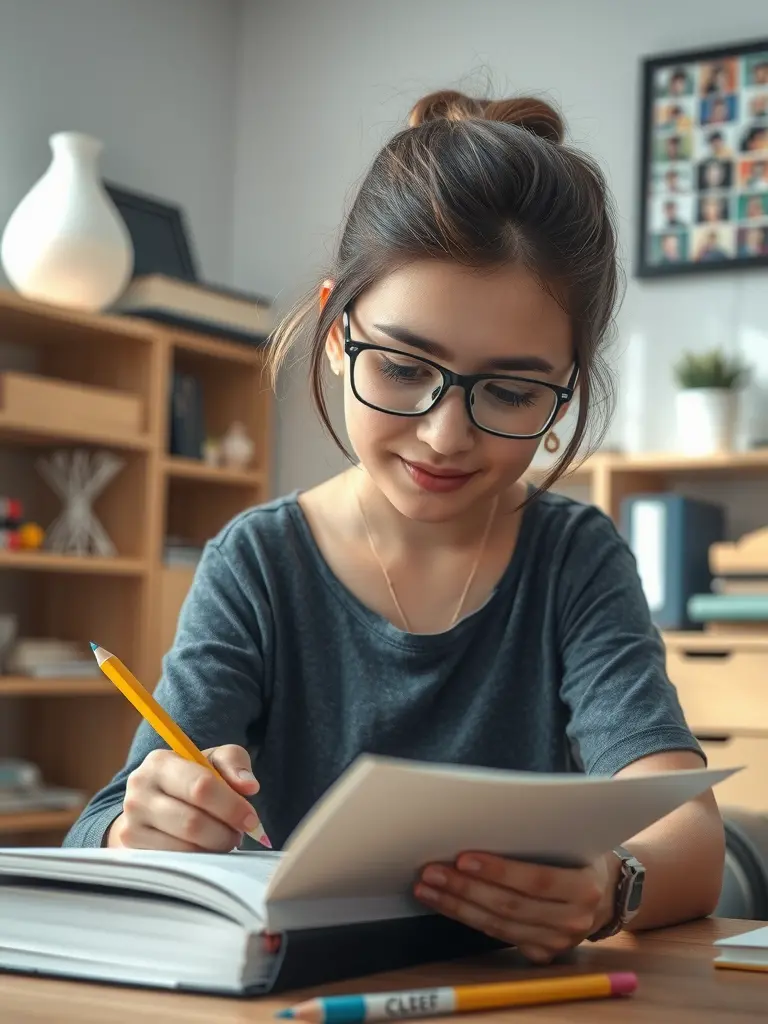
Warm sunlight filters through the white sheer curtains, illuminating this elegant study and seemingly adding a layer of soft light to the interactions between parent and child. Neatly arranged along the walls are bookshelves, displaying children's books, learning references, and folders in an orderly manner. At the desk, a dedicated mother is opening their "educational file box" with her child, preparing for a significant battle concerning learning and organization.
This mother systematically categorizes stacks of papers based on their attributes, cross-referencing them with annual goals and growth logs. At times, she encourages her child to ask questions, while at other times she shares her little tips with a firm yet gentle tone. Her movements flow gracefully, and the child listens attentively, trying to turn the mother’s methods into their own skills, hoping to become a little adept in managing academics and life in the future.
Modern education emphasizes autonomous learning, combining digital resources with paper materials, allowing school life to extend beyond classroom teaching, with a wealth of information flowing around each student. In light of this, the ability to organize and manage learning files has gradually become an important element in home education. For many families, educational files are not just tools for storing assignments and tests; they are treasure boxes that witness children’s growth and accumulate experiences. How to scientifically and efficiently organize these rich learning outcomes has become an important topic for modern parents.
In an interview, this mother generously shared her practical experience of collaboratively building learning files with her child. She candidly admitted that at first, they faced the challenge of “too much stuff and not knowing where to start,” including classroom notes, artwork, math exercises, and personalized goal lists accumulated over the year. Hence, she decided to start with "categorization," initially archiving all materials based on subjects, types of activities, and chronological order, then having the child assist in selecting items that are “memorable” or “helpful for future learning,” stimulating the child’s active thinking and judgment.
In the further organizing process, the mother places special emphasis on "monthly reviews." At the beginning of each month, she reviews the learning outcomes of the previous phase with her child, examining what progress has been made and what areas still need improvement. This process resembles a small parent-child meeting, strengthening the child’s self-reflective abilities, while allowing parents to make timely adjustments to the learning state. Whenever the child suggests their own organizational ideas, such as using color coding for different difficulty levels, jotting down misunderstood knowledge points on sticky notes, or even attempting to create a small mind map, the mother praises them and helps optimize the details.
“Organizing educational files with my child is not just about sorting; more importantly, it’s about establishing a learning context that belongs to them,” the mother emphasizes. She believes that allowing children to learn structured thinking through file management will help them not only read systematically in the future but also apply these skills broadly in other areas of life.
In addition to traditional paper materials, she also actively utilizes digital tools. For instance, she stores her child's electronic assignments and online reports in a cloud folder, organized by semester, and uses digital labels to indicate semester, subjects, and achievements. Even with both paper and electronic materials, by establishing a simple and clear set of organizational rules, the child can easily manage their own learning records. In the mother’s view, "data management" is not about having 'a tidy drawer,' but rather, 'the ability to retrieve files promptly at important moments,' which greatly enhances learning efficiency.
Years of shared learning experiences have led this mother to develop a unique set of "efficient learning and organizing tips," which she is eager to share with parents looking for methods:
1. Establish clear categorization rules
Before starting to collect materials, set a few simple categories such as Chinese, math, science, and social studies. Activities and works should also be organized according to time and content highlights. Clear categorization reduces confusion when searching for materials and improves retrieval efficiency.
2. Schedule regular review and organizing time
Fix a time every week, such as the weekend, to check learning files with the child, discarding duplicates or outdated materials, keeping the database fresh. This not only acts as a ritual but also turns data retrieval into a habit.
3. Combine color coding and visual tools
Utilize folders of different colors corresponding to subjects or difficulty levels. Add illustrations, mind maps, and stickers to notes to stimulate the child’s memory and interest in learning.
4. Arrange regular reviews and goal assessments
At the beginning of the month or at the end of each semester, discuss completed goals with the child, assess learning outcomes, and set new objectives. During this process, guide the child to reflect on "which methods work best for me" and "what I've learned from my mistakes," fostering self-reflective abilities.
5. Integrate digital and paper materials
Use cloud storage to archive important electronic assignments, and regularly scan important paper records into PDF format, reducing physical space stress and ensuring data isn't lost.
6. Use stories to guide motivation in learning
The mother often transforms the file organizing process into a “treasure hunt competition,” allowing the child to discover a sense of accomplishment and confidence. Whenever the child finds assignments that they previously got wrong but have now improved upon, the mother praises, “This is not just learning; it’s a record of your hard work!”
These seemingly simple methods are rooted in the cultivation of management skills and emotional exchanges. Experts believe that organizing educational files is, in fact, a way to develop information filtering abilities. As long as children can consistently maintain this learning habit of classification, condensation, and review over time, they will benefit immensely in future academic pursuits, educational planning, and self-management.
In this efficiency-driven era, many families opt to have parents or tutoring institutions manage all materials for convenience. However, this mother insists on participating in the organizing process with her child. She believes that the greatest value of education lies in children's active participation, self-correcting, and continuously optimizing through constant experimentation, ultimately finding their own system and methods.
In addition to the mother's personal experience, the reporter also interviewed several parents of school-age children, who shared challenges mostly revolving around "child’s resistance to organizing," "disorganized information that cannot be checked," and "failure to utilize electronic materials." In this regard, psychologists advise against neglecting children's subjectivity in the pursuit of temporary tidiness. “Allowing children to try their own rules amid a bit of chaos, as long as the overall direction is correct, will lead them to gain a sense of achievement in the process, which is the greatest significance of data management education.”
In the study, the mother observes her child engrossed in organizing materials, sensing signs of growth in their focused gaze and adept techniques. She smiles and says, “When we diligently organize the past, we are also building discipline and order for the future.” For many parents, steady and methodical learning management is far more important than doing everything for their child. After all, there will come a day when children will steer their own "learning compass."
This warm and humble scene in the home is not just a daily part of family education; it has become a microcosm of the future era of autonomous learning. Each instance of filing, each review of achievements, is a glimmer that lights up the future; as we carefully organize these bits and pieces, perhaps what is truly being tidied up are not just the materials themselves, but the trajectories and confidence of children as they grow independently toward the future. For families that value learning abilities and personal growth, such moments of joint organization are not only healing but also deeply meaningful.