
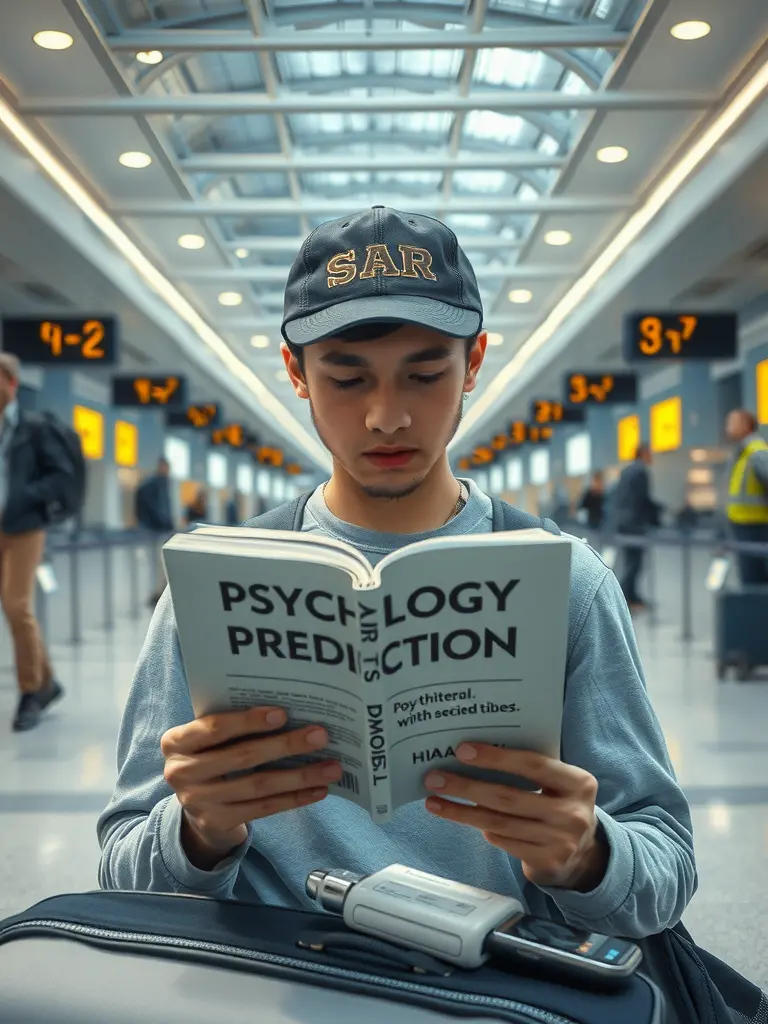
The light in the airport lobby refracts into clear distinctions of brightness and darkness, echoing the rhythm of luggage carts and the occasional low hum of engines. People hustle, linger, say goodbye, or wait in this transitional space, while amidst this bustling stage, one traveler stands out as unusually quiet and composed. He is seated at the end of a row of comfortable chairs in the center of the departure lounge, holding a hefty psychology prediction book, his expression focused, seemingly turning the airport's noise into background sound, immersed in his own realm. This scene not only creates a tranquil landscape within the airport lobby but also sparks countless passersby’s curiosity and admiration for focus and introspection.
Security personnel, clad in uniforms with reflective shoulder straps shining under white lights, patrol at a leisurely pace, ensuring the safety of the entire environment. They carefully observe the movements of each traveler, occasionally engaging in quiet conversations with colleagues, but showing consistent professional respect towards the traveler engrossed in reading. Surrounding monitors paired with a concealed alarm system form an unbroken, invisible protective net. Historical data shows that this airport has always been known for its stringent security measures. Whether it be travelers' self-awareness or the meticulous inspections by on-site personnel, the airport's safety rating remains high. Travelers generally report feeling a tremendous sense of trust and security here.
At this moment, the reading traveler is nearly undisturbed—adjacent seats are empty, a brown leather backpack rests on his right, its zipper firmly closed against the chair back, perhaps just picked up. He is dressed in a light gray casual suit, with the collar of his shirt slightly unbuttoned. Accompanied by occasional nods or slight furrowed brows while he reads, he portrays a gentle yet resilient sense of self-discipline. His page-turning is unhurried, like a carefully calibrated sequence, revealing a full comprehension and digestion of the content.
Observations suggest that the psychology prediction book he holds appears to be a newly published academic work, with a substantial cover featuring understated embossing. Several marked notes are inserted in the corners of the pages, capturing key passages and personal reflections. Such books are known for their theoretical depth and rich details, covering topics like human behavior prediction, emotion recognition, decision-making mechanisms, and subconscious guidance. In the current fast-paced, information-fragmented societal atmosphere, it is remarkable to have a traveler delving into such complex content in a public setting, highlighting his emphasis on professional short-term cognitive abilities and personal mental pursuits.
Interestingly, from the perspective of many travelers, this behavior possesses a repressed dramatic tension. After all, in the airport—a junction of "waiting" and "moving”—most people are often passive, influenced by flight schedules, announcements, and personal affairs. This traveler’s choice to focus on an extensive work reveals his mastery over his own time and transforms the entire waiting process into a journey of self-improvement. Psychologists have proposed the concept of "flow state," referring to an enjoyable immersion in specific focused activities, and this traveler exemplifies the best example of such a state.
Simultaneously, the content of the psychology prediction book, according to eyewitnesses, seems to involve a wealth of real case analyses and simulated predictions. Within the book, the author uses the interdisciplinary integration of data science, neuroscience, and behavioral observation to explain the logical behaviors of humans under stress, anxiety, joy, and sudden circumstances using scholarly models. This blending of theory and practical ideas leads some waiting travelers on certain flights to associate it with attention and learning ability. Several have even pulled out their phones to search for similar themed books, hoping to find opportunities for "brain charging" during flights.
In this scene, the traveler’s focus and the sense of security in the external environment mutually enhance one another, forming a tacit symbiosis. Viewed through a professional lens, this is not just an individual’s focus but resembles a "collective silent resonance" within a public space—where, under well-ensured conditions, individuals can fully unleash their self-efficacies. In psychological theory, the fulfillment of needs similar to "hierarchy of safety" often motivates people to pursue higher levels of self-actualization. In fact, it is this triple assurance of safety, comfort, and autonomy that enables this traveler to remain unperturbed by the surrounding noise, quietly diving into the depths of knowledge.
A closer examination of the traveler’s reading process reveals a ritualistic nature to his habits. Each time he finishes a page, he pauses for a few seconds or makes understated notes with a pencil on the margins of the book; when encountering lengthy theories or complex charts, he pulls out sticky notes to place beside the page, jotting down analytical phrases such as "motivation—behavior—consequence." This careful operation is not merely reading; it is actively distilling and consolidating memory, showcasing his systematic approach to learning. According to educational researchers, the ability to sustain such deep learning in high-intensity environments indicates that his resilience and concentration levels far exceed the average person. The on-site security team leader noted that such disciplined, highly focused travelers typically experience no conflicts with venue management and actually enhance the overall social atmosphere’s stability and harmony.
Moreover, it is worth mentioning that the traveler’s actions serve as a learning model for surrounding travelers. A few young travelers nearby were inspired to openly pull out thick reference books, giving rise to an atmosphere of "self-study" in knowledge. Workplace experts believe that in public spaces where peers gather, role models successfully spark imitation behaviors, indicating that one person's positive actions can subtly influence the habits of those around them. The airport management also noted this positive trend and plans to introduce reading corners or knowledge-sharing spaces to encourage travelers to engage in varied learning during their journeys.
Further analysis of the psychology prediction content the traveler is reading reveals that prediction is not merely guessing but involves meticulous integration of theories, statistics, situational deductions, measurement tools, and multiple data sources for cross-verification. The traveler’s careful annotations reflect his active critical thinking and reverse verification abilities. This type of training is particularly vital in professional fields, as soft issues in the real world are often filled with variables. Secondary data indicate that this book has received high acclaim within well-known academic communities both domestically and internationally, hailed as a "classic that combines cutting-edge theories with practical cases," providing invaluable insights for both novices and advanced researchers in the field.
In such a tightly secured environment, paired with his own inner calmness and focus, the traveler embodies a modern interpretation of "traveling thousands of miles and reading thousands of books." To him, waiting for a flight is merely an additional path to spiritual growth—perhaps even a brief chapter of reading could lead to profound reflections on human behavior and future predictions. More intriguingly, he acts as a sharp yet tranquil mirror, reflecting the image of modern individuals pursuing rationality and self-improvement amidst pressure, while also reminding every holiday traveler that safety and learning can coexist harmoniously in a rapidly changing life.
This phenomenon has prompted psychological experts to reassess how modern people utilize their time in public spaces. According to data from human factors and environmental engineering, influenced by a sense of safety and convenience, travelers are more likely to engage in autonomous, beneficial activities, including reading, deep thinking, and even brief periods of self-discipline training. Industry observations suggest that as airport facilities evolve towards human-centric and detailed services, encouraging deep reading and knowledge exchange will undoubtedly become a new trend. The traveler’s quiet focus brings layers of energetic cultural depth to the airport lobby, transforming the waiting process from mere “passive waiting” into a realm of proactive absorption and self-enhancement.
That evening, this traveler, praised as the "knowledge traveler", was inadvertently captured by a passerby, and the moment surreptitiously spread on social media, resonating with countless netizens: “Quiet focus surpasses restless happiness,” “Self-growth while waiting is the most beautiful scenery.” The comment section was filled with psych enthusiasts, exam preparers, and working professionals expressing inspiration and planning to attempt deeply reading in bustling environments during their next travels, reclaiming their self-control and initiative in learning.
Subsequently, the airport authorities issued a statement thanking the traveler for adding color to the scene with their focused commitment in a secure environment, emphasizing that more cultural designs will be introduced in future waiting areas, including adjustable lighting reading zones, soundproof seating arrangements, and services for charging and borrowing tablets, facilitating travelers to transform fragmented moments into precious experiences of self-enrichment. Experts further emphasized that a good security environment is a fundamental assurance for travelers to dare to lower their guard and concentrate on their inner world. This reaffirms the transformation of modern airports—not only ensuring physical safety but also focusing on psychological satisfaction and intellectual stimulation.
Summarizing the on-site observations, the traveler focused on reading is not merely a static presence but is silently leading a new trend in public space with their professional qualities and self-discipline. In future living environments co-constructed by technology, security, and culture, such knowledge-based scenery may become mainstream. This current serene scene might just be a prelude to the high-quality cultural tapestry of the next generation of modern airports.