
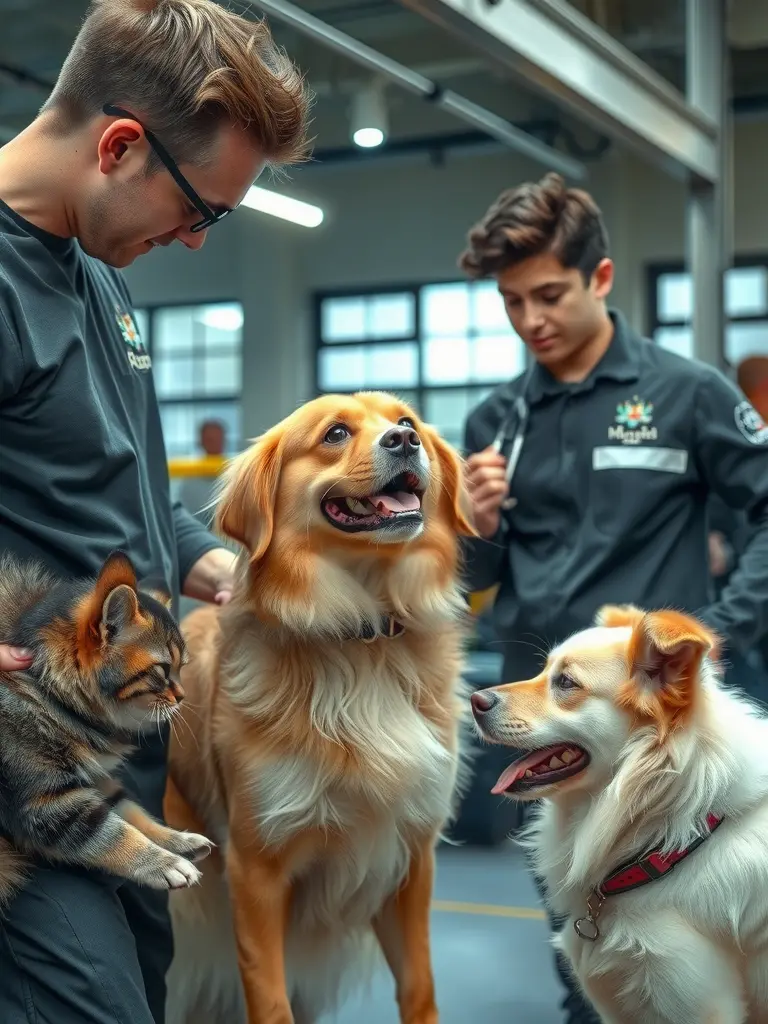
As the warm afternoon sun casts its glow on the spacious, modern living space, an innovative pet behavior training session is about to unfold. Expert pet trainers, with their meticulous patience and rich creativity, are leading a variety of pets through a new interactive training program aimed at changing the public's old perceptions of household pets' learning abilities and communication methods. This indoor pet training is not just a teaching demonstration; it embodies a lifestyle aesthetic, bringing an interactive curriculum that typically belongs to vast outdoor spaces right to the doorsteps of urban pet owners.
The trainers are dressed in well-tailored professional attire, featuring cool tones of light gray, ice blue, and pure white, echoing the modern design of the space. They have chosen low-reflective, easy-to-clean functional fabrics that suit the needs of long hours spent with various animals. Equipped with minimalist tool bags that are close to the body, they have quick access to treats for praise, training cues, and fun props. The space is filled with natural light, creating a bright and transparent atmosphere, allowing each pet attending the "class" to showcase their vitality in a relaxed and enjoyable environment.
The training area is cleverly divided into multiple independent sections. The main area features realistic artificial grass, lightweight jumping hurdles, variably shaped tunnels, and even climbing slopes and multifunctional training equipment. Each facility has been meticulously considered to accommodate the physical characteristics and psychological needs of diverse pets, including cats, dogs, rabbits, parrots, and even miniature pigs. Bright, colorful signs are placed throughout the area, clearly indicating the function of each training zone, making it easy for first-time observers to understand.
What truly grabs attention is the trainer’s innovative training concepts. They combine the theories of "free shaping" and "positive reinforcement," emphasizing guiding learning while respecting the pets' freedom and instincts. For example, indoor cats are no longer just trained to shake paws or perform simple rescues; instead, they learn how to use gaps between furniture and safe climbing spots, encouraging them to confidently explore new routes during playtime while establishing household rules to prevent mischief. For dogs, the training progresses to more advanced behavioral techniques, including quiet companionship, self-restraint when the owner leaves, and recognizing the sounds of their owner’s daily routine. For instance, by regularly playing the sound of a doorbell, dogs can learn to choose to wait quietly, thus reducing excitement when unexpected visitors arrive.
Most surprisingly, this trainer has broken conventions with small animals. They train rabbits and miniature pigs to understand simple commands and complete designated routes, incorporating building blocks and color cards to achieve learning goals. Even more creatively, parrots at the venue learn to identify toys based on colors and respond to sound games, learning to select specific toys based on their owner’s instructions, and even tap bells with their little feet. This training not only showcases the intellect of pets but also enhances their level of interaction with humans.
The ongoing training process is orderly, emphasizing observation, communication, and adaptability at every step. The trainer is constantly attentive to the pets' emotions and the psychological burdens of novice owners. They explain that continuous high-intensity practice should be minimized, favoring shorter, more frequent interactions, allowing time for animals to rest and observe one another. When a pet completes a target action or proactively demonstrates learning rather than passively obeying, the trainer immediately praises them in a gentle tone, coupled with an appropriate amount of treats or toys as positive feedback, fostering a long-term motivation for learning.
The atmosphere in the training area is casual, filled with laughter at times, while at other moments, there are quiet observations. There are constant expressions of surprise and admiration from owners witnessing their once-mischievous, timid, or skeptical pets gradually shift towards active exploration and embracing challenges. The organizing team has also designed instant cameras and screens for playback, assisting owners in reviewing their pets’ improvement processes. This not only adds fun but also allows for a visual and evidence-based shared experience regarding understanding within the owner-pet relationship.
It is noteworthy that the trainer emphasizes cultivating the pets' self-regulation abilities. For animals that are easily startled by external stimuli, such as overly alert cats or independent small dog breeds, the courses integrate gradual principles of environmental adaptation. Initially, animals are familiarized with surrounding smells and sounds in a quiet state, gradually introducing light background noise and simulating their owner's daily activities before entering high-interaction scenarios. This approach increases pets' tolerance to environmental changes, moving away from the traditional rigid "one teaching is enough" training model towards a "lifelike integration" philosophy.
In addressing behavioral issues that trouble many owners, the trainer advocates for “prevention over correction” as a basis for pets to learn alternative positive behaviors. For instance, to curb a cat's screaming or furniture scratching, dedicated scratching areas and varied-height jumping platforms are established, along with interactive points incorporated into the home route planning. To address separation anxiety in dogs, a quiet, self-accessible space is created, allowing the dogs to enter and exit autonomously. Additionally, the trainer demonstrates various simple daily interactions that do not require expensive equipment, using only small items readily available in the home, fully unleashing creativity and love.
Another novel approach involves introducing simplified interactive board games for shy, sensitive pets. The trainer uses puzzles and bead mazes as interactive toys, gradually escalating difficulty based on each animal’s observational feedback with scientific methods. Throughout the process, all steps are carefully documented for behavioral observation and data analysis to find the best individualized learning plan. This not only elevates the training process beyond a mere showcase of individual "skills" but also integrates it into scientific behavioral research.
It is worth reflecting that training learning is never just about an animal's "adaptation"; it is also the key to mutual understanding between owners and pets. The trainer timely invites owners to participate in interaction processes, observing if their cues, actions, or expressions may lead to misunderstandings for their pets and providing real-time corrective suggestions. Many owners report that after professional guidance and shared learning experiences, they realize their previous unconscious pressure and impatient tone were the most significant factors causing their pets' hesitation or even aversion to training.
The professional trainers share that when designing innovative courses, they choose "life is training" as the core concept. They hope that through diverse indoor interactions, pets can replicate situations and challenges they may encounter in real life. For example, when a vacuum cleaner starts during a thorough cleaning, pets should not panic excessively; or with the mail carrier’s arrival under guidance, they can maintain composure; and even when guests laugh and the environment changes at home, they develop resilience to adapt flexibly. This training mindset reflects how modern household animals are increasingly seen as part of the "family," shifting from a past focus on pure service and obedience to a new era of mutual trust, cooperation, and growth.
The course design also has another meaningful purpose—connecting with the daily routines of pet owners, eliminating unnecessary travel while developing a "time-slice learning method," allowing busy individuals in the fast-paced modern world to utilize fragmented leisure moments to enjoy enriching and pleasant interactive time with their pets. Many owners describe this as not only a transformation for their pets but also a "spiritual recharge" process for themselves.
The event underscores subtle changes in pet behavior theories on the market. Trainers emphasize that innovative training does not seek to demonstrate extremely high levels of skill but rather returns to the psychological essence of animals, allowing every pet to explore its potential within an environment of trust, safety, and joy. Under this philosophy, pets are no longer cold "learners" but companions exploring the world alongside their owners. The trainer also reminds owners that overly rigid methods or overly eager goals can easily backfire. Reasonable expectations and professional guidance can alleviate mutual pressure, creating a warmer companionship relationship.
At the end of all courses, the trainer provides written behavior reports and personalized advice based on each pet's behavioral recordings and observations, assisting owners in the continued progress of their pets. This professional report is not just a score but serves as an understanding, encouragement, and living guide, motivating each owner to continue supporting their pets and growing together.
By holding this innovative training showcase, it is akin to announcing the arrival of a new wave in home behavior education. Faced with the constraints of modern urban environments and busy owners' schedules, the thoughtfully designed multifunctional environment and clever interactive games by expert trainers, combined with systematic observation and positive philosophy, are the driving forces for promoting a better life for both pets and their families.
As the owners orderly depart the scene with their beloved animals, one heartwarming, fun, and inspiring story after another quietly unfolds under the new training model. It is foreseeable that this professional training, centered around respecting individual animals and flexibly integrating into modern family life, will undoubtedly become the preferred training choice for the new generation of pet owners, leading the entire field of pet behavior education toward a more diverse, scientific, and compassionate new height.