
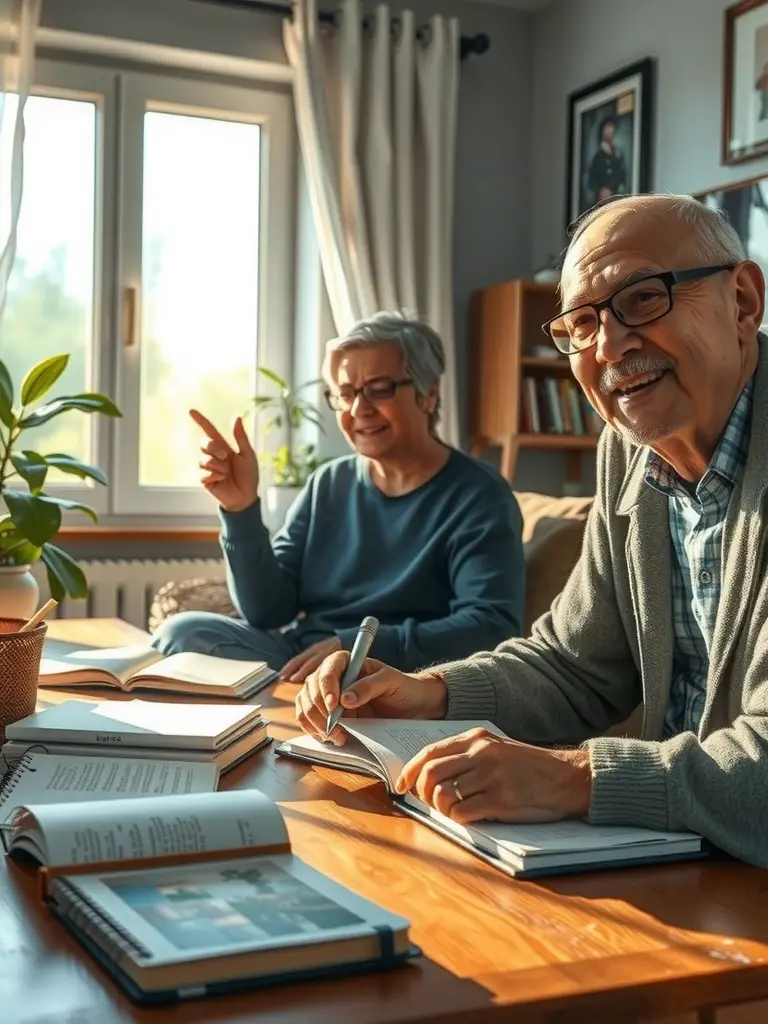
The magical adventure of language learning often quietly unfolds in some corner of life. The gentle early summer sunlight spills onto the window sill, where a cozy living room is presenting a touching scene filled with knowledge, familial love, and the interplay of generations. A wooden bookshelf is filled with various books, and the intricate texture of the desk reflects the shadows of books and notes in the sunlight. Sitting beside the sofa is a spirited elder, whose smile not only carries the calmness of age but also embodies a passion for imparting wisdom. Beside him is a nervous yet eager novice learner, and their conversation is interwoven with the syllables of the language and rich emotional fluctuations.
Language learning is not just about the transfer of knowledge; many often overlook the hidden spiritual exchange and life stories within it. In this small living room, everything symbolizes the true nature of language education: carrying the past and illuminating the future. The process of the elder personally guiding the novice in language learning delicately showcases the emotional interaction between generations and cultural transmission.
The story begins on a lazy afternoon. The sycamore tree outside sways gently in the breeze, casting dappled shadows on the white curtains. The kind-faced elder, wearing a simple knitted sweater, sits in a single sofa near the window. He is not just a navigator of language, but also a guide on the journey of life. For the novice, language learning is like entering the vast ocean for the first time, and this elder is a skilled helmsman, leading the learner to gradually sail through the sea of unknown knowledge.
On the table are beginner-friendly language learning books, along with a thick notebook for recording inspirations and notes. Additionally, there are a few mechanical pencils and a pencil case, showing the household's emphasis on learning and professional attitude. Sunlight filters through the half-closed window, warmly illuminating the pages and the back of the learner's hand, reflecting the warmth of this learning journey.
"The most important thing about learning a language is being willing to speak and daring to make mistakes," the elder says patiently, his tone gentle and soothing. The novice listens attentively, occasionally jotting down key words. The biggest obstacle in language learning is not grammar or vocabulary but rather psychological fear. Many beginners tend to hesitate and hold back due to fear of mispronunciation or incorrect usage. The elder's smile acts like a mirror, reflecting the confidence and composure necessary in the learning process.
As the lessons progress, they explore the intricacies of the language step by step. For instance, the elder uses everyday scenarios to let conversations happen naturally. "If we were to buy fruits, how would you ask using this language?" The novice thinks for a moment, trying to assemble the sentence structure just learned. Though it starts off a bit awkwardly, with the elder's warm encouragement, it gradually becomes smoother. Whenever the novice successfully expresses themselves, the elder always nods in approval, occasionally giving a reassuring pat on the shoulder—this form of body language, along with verbal encouragement, makes the learning atmosphere even more warm and dynamic.
Another important aspect is the significance of taking notes. In this living room, the notebook serves not only as a platform for recording knowledge but also as a testament to the novice's emotional journey. The elder suggests compiling new vocabulary, grammar, usage, and daily dialogues into summaries, reviewing and revisiting them regularly. The notebook is filled with corrections and revisions as well as spontaneous inspirations recorded, such as vivid example sentences or communication anecdotes encountered in real life. Learning extends beyond the desk and into every moment of life.
As the sunlight flows into twilight, the temperature and atmosphere become increasingly warm. The learner gradually builds confidence through repeated practice and even begins to challenge more complex conversation topics. The elder provides timely additional social and cultural context, as well as different applications of the language in real life. Language learning is inseparable from culture; behind every language lies extraordinary historical facts, profound values, and unique expressions. The elder skillfully incorporates proverbs and colloquialisms into the lessons, allowing the novice to appreciate the lively side of language.
Throughout this exchange, the learner is no longer just a passive recipient of knowledge. Sometimes they express their understanding or life connections regarding confusions, engaging in discussions with the elder. Such interactions promote reciprocal growth—the elder gains new insights and perspectives from the younger generation while the learner draws on broader cultural viewpoints. The distance between the two generations seems to gradually shorten in the corner of the desk.
However, the challenges of language learning do not resolve overnight. Whenever learning hits a plateau, the novice inevitably shows signs of frustration and doubt, but the elder always uses personal experiences as encouragement, recounting how they once overcame language barriers and turned abstract knowledge into enjoyable little games. The elder deliberately points out common mistakes, laughing together with the learner, turning errors into stepping stones instead of stumbling blocks.
In this language adventure, there are bits of care woven throughout life. Sometimes the elder serves a cup of hot tea at the end of the lesson, thoughtfully reminding the learner that space for mental and physical relaxation is also necessary. The afternoon sunlight gently falls along the window frame, and in that silent moment, it seems to narrate: the taste of learning should be like this—warm, rhythmic, and accompanied.
For this novice, this is not just an enhancement of language skills, but a journey of self-discovery, mutual understanding, and integration with life. Writing life notes in a new language, reading foreign literature, and meeting friends from different backgrounds, the door to a new world quietly opens. Through language, the perspective of life broadens, adding much interest and surprise to what once seemed ordinary.
Furthermore, this mode of learning gradually becomes a new trend within the community. Word of mouth among neighbors has led many families to emulate this “living room academy,” transforming their most comfortable spaces into vibrant learning environments. Elders not only pass on life wisdom but also draw new viewpoints from the younger generations. The living room is no longer just a place for casual chats, but has become a space for stimulating creativity and mutual growth.
As times change, many language learning methods are evolving rapidly, but the warmth of face-to-face communication remains irreplaceable. Experts point out that the most effective way to learn a language is to progress gradually in real-life contexts, combining practical application with gentle guidance, which is far more lasting and enjoyable than cold online courses or exam-oriented teaching.
Some scholars argue that "spatial warmth" and "psychological safety" are crucial for language learning. In such environments, there is no separation of authority between teacher and student, but rather equal sharing and sincere communication. This sense of ease and safety is the most precious source of motivation for continuous learning.
Starting from a living room bathed in afternoon sunlight, this small scene reflects great educational ideals. Every detail, every interaction intricately writes a new chapter belonging to language, life, and familial bonds. It is not just the transmission of knowledge, but also a dialogue of the soul, a connection of memories, and the brave steps toward a larger world.
The next time you sit by your window, consider opening a book in a foreign language, picking up a notebook; perhaps the same story is quietly unfolding between you and your family without you even realizing it. Maybe this simple yet pure learning scenario is the beginning of countless seeds of knowledge for the future. In every ray of sunlight and every page of notes, plant the language dreams that belong to you and your family, and looking back, you will see stories full of warmth and hope gently flowing through time.