
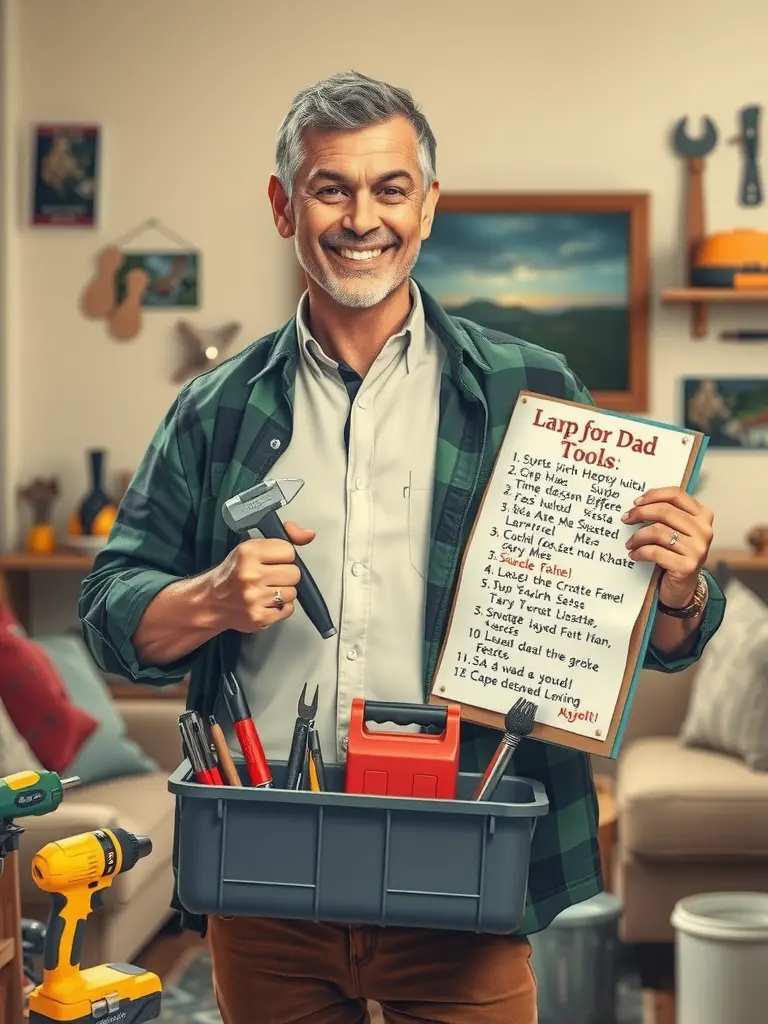
The sunlight filters through the sheer curtains, spilling warmth into the living room, which is a space filled with a family atmosphere. The soft light brown sofa is piled high with childhood toys, while the bookshelf displays various storybooks and travel magazines in an irregular arrangement. On the wooden coffee table, crumbs from breakfast and a half-full cup of hot cocoa are left behind. A tall figure, wearing a casual T-shirt and relaxed pants, stands in the center of this cozy domain—he is a father holding a multifunctional toolbox. The outer layer is marked with thoughtful reminders, and the tools inside are neatly arranged, allowing one to imagine the care and professionalism of this dad. In his other hand, a stack of paper lists lies quietly, densely filled with various languages: Chinese, English, Japanese, German, Spanish, French… Though the fonts differ, they all share a common theme—“Emergency Home Repair Tasks.”
This is not an ordinary family life report, as this father's story is intriguing and inspiring. Behind his smile lies a simple yet increasingly rare ability: how to address small issues in life, equipped with skilled hands and a keen heart, in an age of information overload. He also innovatively passes on this ability to family members and even promotes it within the community.
Home repairs stem from the details of love.
The “Home Living Survey Report” indicates that over 70% of modern urban residents seek outside help when faced with small repairs at home (such as appliance malfunctions, loose furniture, or creaky doors and windows). This father goes against the trend: not only is he skilled with various common household tools, but he has also extended this skill into a multilingual knowledge list. Whenever a light bulb goes out, a chair creaks, or a child’s remote-controlled car wheel axle comes loose, he can confidently and effortlessly pick up his toolbox and resolve the issue.
At the same time, he has specially designed a multilingual checklist for household repairs. This not only serves as a reminder for himself when traveling but also acts as a learning material for family members. When asked about the origin of this list, the father chuckles: “Initially, it was just to help the kids at home learn languages, but it unexpectedly became practically useful.” It turns out that the names of various tools and their usage steps are marked in different languages, which not only enhances the children's language abilities but also boosts everyone’s confidence and efficiency in repairing appliances and furniture.
Deconstructing the toolbox magic—intersection of professionalism and everyday life.
To say that the toolbox is his small universe is no exaggeration. It contains screwdrivers, a hatchet, a mini drill, a measuring tape, adjustable wrenches, and even a special kit for repairing mobile phones and tablets. These tools are categorized and arranged based on common fault scenarios, clearly labeled with their types and uses. He firmly believes that a good tool configuration is the foundation for repair work. In addition, he thoughtfully prepares some special tools—like leak detectors, magnetic clips, and electrically insulated gloves. Discussing this tool configuration, he analyzes seriously: “Every family needs at least one basic tool set. It is not only a guarantee for daily maintenance but also a first aid kit in emergencies.”
The process of home repairs has become an interaction. Every weekend, he invites the family to participate together in “DIY Household Time.” The father selects a task from the list and guides the children and partner in doing it. Under his guidance, the little ones learn to assemble toys with screwdrivers, while the adults tidy up the bookshelf and clear the bathroom drains. With each action, he repeats the steps in several languages: “Turn the screwdriver gently. 巧妙地轉動螺絲起子。みぎにまわして—向右旋轉。” This practice not only cultivates practical skills but also subtly promotes emotional connections among family members, making language learning engaging and natural.
Recreating the scene: a documentary of family repairs.
Recalling a recent home repair, a leaky bathroom faucet incident became a classic teaching moment. One leisurely afternoon, the family noticed dripping sounds from the bathroom. The father immediately took action, leading the family into “repair mode.” Like a makeshift workshop, newspapers were laid on the floor for safety, and tools were set out one by one. The father first explained the cause of the malfunction in Chinese, then supplemented it in English and Japanese: “Check the washer ring. 檢查密封墊圈。パッキンを確認しましょう。” The children eagerly followed their father’s instructions, carefully observing each step from removing the handle to unscrewing the nuts, almost like solving a technical puzzle. Finally, guided by the father, they reinstalled everything, and when the water flowed freely again, everyone erupted in cheers. The mother humorously remarked, “Faster and more professional than a repairman from takeout!”
Unknowingly, every repair session became a form of family education. While they developed observation and problem-solving skills, children also learned practical vocabulary in different languages. For the father, this process of passing down skills is more meaningful than merely fixing faults; he always encourages family members to think and try actively: “Repairing is not just a craft but also teamwork and a fusion of knowledge.”
The charm of multilingual moments in the living room.
In addition to the sense of achievement from hand-crafted repairs, humorous incidents arising from multilingual interactions also animate this tradition. The checklist features names of everyday tools in different languages, like “Tournevis” (screwdriver in French), “Hammer” (Deutsch), and “Llave inglesa” (wrench in Spanish). During the repair process, children would compete to see who could correctly say the name of the tool. Occasional mispronunciations or misunderstandings brought laughter, and the father would add a playful note: “Get that ‘Travel-knife’—wait, is it actually ‘Tape measure’?” In this unique family atmosphere, mistakes turn into opportunities for learning and communication.
As time accumulates, the “multilingual repair corner” at home has gradually enriched, adding to the checklist and tools drawings by children showing how to use them, plus small vocabulary cards. These homemade teaching materials are occasionally posted on walls or the refrigerator door, creating a unique space for language and scientific exploration.
Professional interpretation: the connection between multilingual backgrounds and skills education.
Family education experts indicate that hands-on learning in a multilingual environment has positive effects on cognitive development. By linking different languages with concrete operations, such as DIY repairs, it strengthens memory and creative thinking. The father's approach perfectly illustrates this point. By integrating everyday life scenes with language learning, he not only lowers the psychological barrier of learning a language but also enhances family members' ability to integrate knowledge.
At the same time, psychological studies show that participating in practical activities during parent-child interactions can effectively promote parent-child relationships and communication skills. Each collaborative household task is a journey of role division, information transfer, and exchange of ideas. For children, this “learning by doing” method is far superior to just theoretical discussions.
The aesthetics of home repairs—creativity, environmental protection, and sustainability.
The family’s approach carries even deeper significance. In the face of waste utilization and environmental protection trends, DIY repairs showcase the modern family’s aesthetic and sense of responsibility. For instance, the father leads the family in making storage racks from discarded wooden boards and reusing fabric to sew curtains, reducing waste while enhancing the beauty and functionality of their living space. Broken toys undergo “minor surgeries” to regain their vitality instead of easily becoming garbage. Behind every DIY project is the practice of family values and education in fostering environmental consciousness in children from a young age.
Promoting to the neighborhood community—impact from family to society.
With the transmission of repair skills and the multilingual checklist, neighboring families have also begun to draw inspiration from this creativity. Thus, the monthly “Neighborhood DIY Exchange Day” was established. Neighbors bring small items that need repair, and the father and his family volunteer as instructors, teaching on-site how to patch clothes, check plumbing and electricity, and assemble furniture. Occasionally, there are fun contests, such as “fastest table and chair assembly” and “most languages in naming,” making the learning atmosphere relaxed and lively while greatly enhancing community cohesion.
The local family education promotion association expressed high recognition for this practice. A spokesperson analyzed: “Combining multilingual education with hands-on repairs is an extremely valuable implementation of modern literacy education. It promotes practical skills, language communication, problem solving, and environmental awareness, benefiting both children and adults.”
Looking to the future: igniting learning enthusiasm through creativity.
The daily life scenes of this dad and his family offer a new educational model. He makes family repairs an entry point for children to explore the world, practice knowledge, and feel love and warmth. It is not merely about handling daily chores but also a holistic nurturing combining rationality and emotion. The understanding and creativity among family members fill everyday life with novelty and laughter. Each sound of the tools and every colorful language expression accumulate as wisdom from everyday life.
This is not just a warm family story; it also contains profound insights into modern family education, life aesthetics, and community cultural development. Regardless of where one is, everyone can discover the power of coexisting together—that is a happiness formula woven from love, professionalism, and creativity, perhaps worthy of more families to reflect on and learn from.