
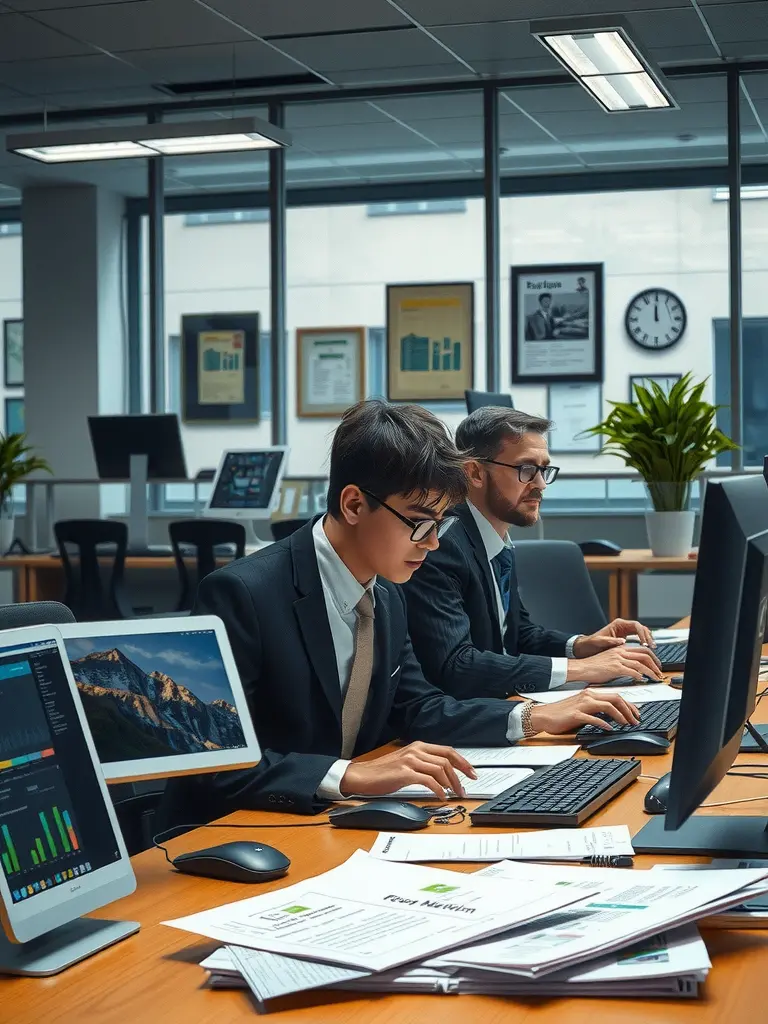
Walking into a modern office, a busy scene comes into view. Transparent glass partitions cleverly separate the various departments while allowing a comprehensive view of overall collaboration; the rhythmic sounds of high heels and leather shoes tapping on the carpet seem to add an invisible push to this sprinting space. Time appears to move particularly swiftly, with every corner saturated by a high-efficiency atmosphere. The bright screens reflect the professional office workers seated at their desks, eyes focused and hands swiftly striking the keyboard, sometimes moving the mouse, sometimes switching application interfaces—handling intricate file processing and responding to inquiries in real-time has become a daily routine.
In this office supported by high technology, laptops, tablets, and smartphones are ubiquitous on desks, with some even using smartwatches as important carriers of notifications. Professional workers must not only master office software and cloud collaboration but also keep track of instant messages from various communication apps, calendar reminders, and remote meeting invitations. A pile of scattered documents on the desk, mixed with project reports, financial analyses, product introductions, and internal notifications, narrates the new daily routine of modern office life alongside high-tech equipment.
A female employee wearing wireless headphones is simultaneously organizing spreadsheets while listening to a client's voice message. She occasionally frowns and quickly takes notes, with the latest model tablet on her left, displaying that meeting records are about to be synchronized to the cloud. Her right hand skillfully operates the keyboard, responding to the latest questions in the departmental group. This scene of human-computer collaboration not only demonstrates individual professionalism and multitasking resilience but also implies that today's office culture is at the peak of the digital wave.
In the center of the office desk, a sleek, newly designed document scanner is starting up at high speed, while adjacent colleagues quickly feed contracts to be scanned into it, as the automated process eliminates the era of manual data entry. The aroma of coffee intertwines with brunch delivery boxes, indicating that even amidst busyness, people do not forget to invigorate themselves with a cup of rich coffee. Some are explaining product specifications on the phone, while others, wearing noise-canceling headphones, focus on data analysis or optimizing data visualization dashboards.
This high-efficiency atmosphere also reflects in daily internal communication. Common questions and answers seem to have formed an invisible set of rules; whenever someone throws out a question in the group or private message, such as "How do I apply for leave?" or "When is the finance report due?" someone immediately reproduces templates based on past experiences or directs them to the shared cloud database. This kind of instant sharing and mutual assistance not only saves significant communication costs but also makes information transfer more transparent and precise.
A fresh graduate in information engineering happily shares, "When I first entered here, my biggest shock was how efficiently everyone processed work using technological tools—many things can be confirmed and executed in just a few minutes or with a few messages." He points to the instant messaging software on the screen: "For example, when someone asks where a file is, you can immediately throw out a cloud link, and the version control is perfect, so there’s absolutely no confusion."
However, behind this efficiency lies a high demand for meticulous processes. For instance, the confirmation and signing of an important contract must undergo multiple online reviews, with each modification clearly noted and documented throughout the process. While these rigorous steps may be cumbersome, they significantly reduce the likelihood of misunderstandings and disputes. To prevent information from slipping through the cracks, many companies have implemented automated notification systems, ensuring that relevant responsible colleagues are immediately alerted if any step is incomplete. This keeps the entire project progress functioning like well-aligned gears, operating precisely.
From a spatial planning perspective, the new office area strongly emphasizes flexibility. There are focused workstations for handling complex tasks alone and open discussion areas encouraging teams to spark new ideas at any time. At lunchtime, some choose to sit by the window and share moments of relaxation, while others hold marathon-style project presentations in the meeting room. This diverse approach aims to meet the needs of employees with different functions and personalities, thus invigorating creativity and collaborative sparks.
In addressing common questions, modern offices increasingly rely on automated customer service or intelligent assistant tools. By simply asking, "How do I handle equipment failure?" the system can automatically respond with repair processes and contact information for the responsible person. This automation of frequently occurring Q&A not only significantly reduces labor consumption but also enhances the overall flow of information. Notably, these tools often preserve every inquiry record, facilitating future tracking and referencing.
The technological devices on the office desk perfectly embody the power of digital transformation. From wide-screen monitor-keyboard setups, laptops, and high-speed fax machines scattered across various corners, to charging stations and plug-and-play multi-port expanders surrounding the space, everything is designed for immediate use. Staff members might even carry portable projectors, projecting slides onto meeting room whiteboards at any moment to widen discussion horizons. These technological instruments are not just decorations; they play a substantial role as catalysts in driving business processes and enhancing communication efficiency.
A senior manager notes, "A good office environment is not just about external style; it prioritizes supporting personnel in maintaining high efficiency and focus. We invest not only in aesthetically pleasing desks and chairs but also emphasize whether each device can genuinely ease the burden on our colleagues, allowing everyone to channel more energy into the most critical decisions and creative processes."
Yet, behind all this high-efficiency operation, there remains a human warmth and delicate care. In the break room, people constantly exchange morning anecdotes and life reflections, and occasionally someone brings homemade treats or fruits, adding a touch of warmth to their tight workdays. During team projects, experienced colleagues are happy to guide new employees, drafting detailed operation manuals, and even jumping in to assist immediately when the system malfunctions. This atmosphere of mutual assistance means that everyone, while busy, is not alone, as they develop a sense of rapport and trust among one another.
From another perspective, this "efficiency" is essentially built on a high degree of division of labor and clear responsibilities. Project coordination is handled by specialized coordinators, financial checks are left to accounting professionals, and technical inquiries are resolved one by one by senior engineers. Each person functions like precisely operating gears, focusing on performing their duties to the utmost while also closely coordinating when collaborative efforts are needed. This assembly line-like precision of division of labor not only enhances process safety but also significantly improves decision-making efficiency.
Although the documents on the office desk seem impossible to clear completely, the new generation of workers is actively attempting to move towards "paperlessness." Every approval, every meeting, and every task delegation prioritizes the use of digital document flows and electronic signatures. For the office, this transformation signifies a more flexible and swift operational model while also adding a new layer of practical significance to issues of information security and environmental protection.
If we summarize the scenes of such modern office efficiency, we can identify several key features worthy of deep reading and learning. First, a solid information infrastructure and the use of digital tools are prerequisites for high-efficiency work. Everything from internal cloud databases to automated notification systems, as well as diverse communication and collaboration platforms, are crucial tools for boosting productivity. Secondly, flexible spatial planning and diverse collaboration methods allow employees to adjust their task handling approaches according to the nature of the work or personal habits. Additionally, actively promoting paperless and automated processes not only reduces the burden of clerical manpower but also contributes to environmental sustainability.
Moreover, it is noteworthy that in an efficiency-driven office environment, the role of "people" has not been replaced by technology. On the contrary, technology has become the key to unlocking human potential, allowing individuals to focus on more valuable and creative decision-making and projects rather than merely consuming their time on daily repetitive tasks. This office culture, which combines delicate human care, high digitization, and scientific division of labor, is gradually reshaping the image of the modern workplace.
From a personal perspective, every professional worker continuously engages in knowledge upgrades and self-growth on this efficient stage. They adeptly learn the latest office applications, master multiple screen switches, skillfully summarize work experiences, and actively integrate new technologies into their daily routines. Whether it is backing up data on cloud drives, beautifying presentation templates, or streamlining remote meeting collaboration processes, each small step makes office life smoother and more natural.
When facing challenges and pressure, modern workers know how to use time management tools to list and break down their daily tasks, set priorities, and learn to relieve emotional stress in a timely manner. When things get overwhelmingly busy, colleagues voluntarily offer assistance or timely suggest team gatherings to share problem-solving tips, which not only enhances cohesion but also fosters a proactive attitude towards problem-solving.
In conclusion, the modern office has transformed into an innovative stage that connects people, technology, and imagination, rather than merely a simple space for handling official business. On this stage, each worker performs like an excellent musician, playing a workplace melody full of efficiency and warmth amidst the digital tide. In the future, this new office style, which harmonizes high efficiency with human elements, will undoubtedly continue to lead the entire workplace ecosystem forward.