
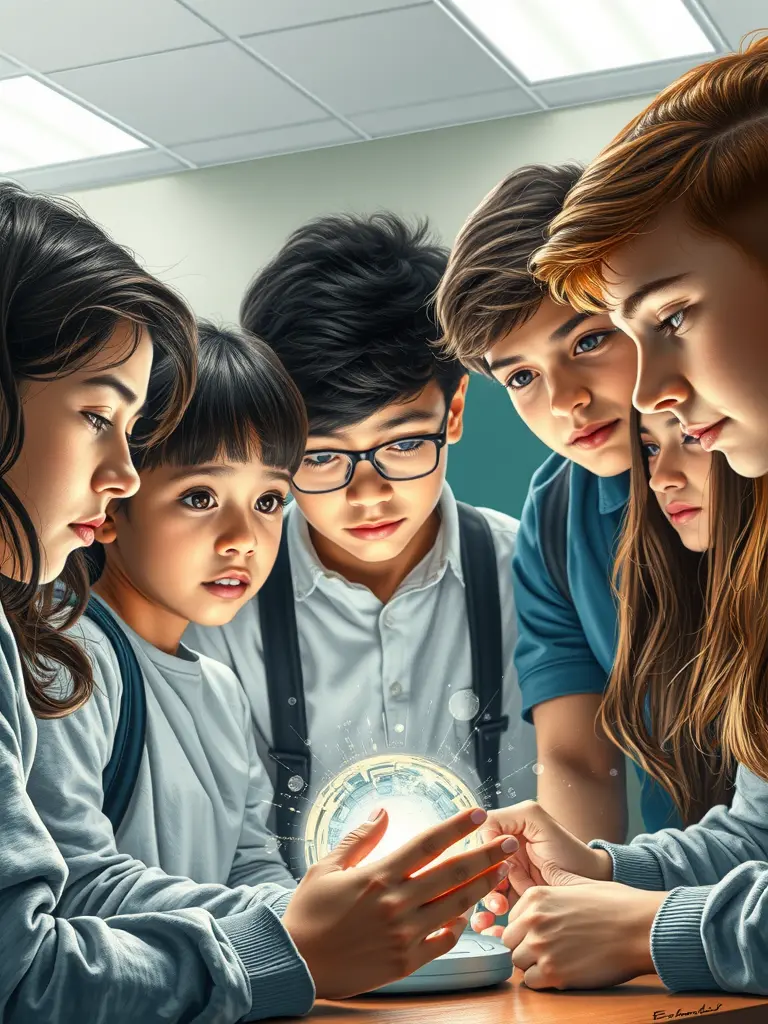
In a bright classroom, gentle sunshine streams through the windows, illuminating a colorful and futuristic technological device. This device not only captures the students' attention but also sparks a lively discussion. Several students sit around the device, their faces radiating excitement and curiosity as they share various ideas and tips through brainstorming.
This technological device, known as the "Smart Learning Platform," is not just an ordinary teaching tool. It integrates cutting-edge technologies such as virtual reality (VR), augmented reality (AR), and artificial intelligence (AI) to provide students with an interactive learning experience. Wearing specialized headsets, students enter a brand-new learning environment through virtual reality. Here, they are no longer limited to traditional textbooks, but can immerse themselves in exploring various scientific phenomena, dissecting organisms, and even visiting historical scenes.
In one group, a student excitedly tries to demonstrate to her classmates how to conduct scientific experiments using this device. As her finger gently taps the touchscreen, her classmates hold their breath, their faces filled with anticipation. As the images on the screen change, they can see the motion of water molecules at different temperatures, accompanied by simulated sound effects that make the experience even more vivid. This format not only makes learning fun but also enhances their understanding of knowledge.
In another group's discussion, some students begin sharing their discoveries from using the device. They discuss ways to apply scientific knowledge to everyday life and present many innovative ideas, such as how to use principles of physics to design an automated household device. These thought-provoking exchanges not only enhance their creativity but also help them understand the importance of teamwork.
The atmosphere in the classroom becomes increasingly vibrant, with students' laughter and discussions intertwining, showcasing the motivation and inspiration brought about by this technological device. The students are no longer passive recipients of knowledge; they have become explorers and creators of knowledge. They freely express their creativity, whether it's about robot design or concepts of new eco-friendly materials and applicable mathematical formulas, all showcased on this technological stage.
Such scenes are not coincidental; they represent a fundamental shift in today's educational model. Modern education increasingly emphasizes the integration of STEAM (Science, Technology, Engineering, Arts, Mathematics) education, effectively blending knowledge from various disciplines to provide students with a more diverse perspective in an interdisciplinary learning environment. This training method equips them to adapt to the challenging future job market.
Experts point out that the rapid development of technology is leading an educational revolution. These new learning platforms not only encourage students to participate more actively in learning but also cultivate their critical thinking, collaboration skills, and spirit of innovation. In the near future, similar devices will be promoted in more schools, becoming important partners in every student's learning journey.
As the discussions deepen, the students gradually formulate specific research and development plans. They begin to plan how to use this platform to design a small smart device called "Green Energy," aiming to raise awareness of environmental protection. They hope that this device can not only provide convenience in daily life but also spark broader attention towards sustainable development.
This project becomes the cornerstone of the students' teamwork, as they collaborate, with some focusing on device design, some on data collection and analysis, and others on testing and assessment. Every quiet discussion in the classroom is filled with anticipation, and as innovative ideas emerge one after another, the students demonstrate their curiosity and aspirations for the future.
After a period of effort, this group of students finally breaks through and turns their research and development plan into reality. The product they designed not only possesses practicality but also engages users in the effective use of energy. A highlight of this project is its eco-friendly concept, which utilizes data-driven methods to unconsciously develop habits of resource conservation among people.
As this achievement is showcased, proud smiles fill the faces of the students. They understand that their efforts are not just part of the learning process, but a journey of gradually realizing their dreams. Their small presentation attracts the attention of students and teachers from nearby classes, with warm applause and praises interweaving, making them feel the hope for the future.
The classroom of the future is not just a place for knowledge transmission, but a fertile ground for inspiring wisdom and cultivating abilities. In such an environment, students are no longer silent learners; they are active creators. Harnessing the power of technology and teamwork, their ideas can be rapidly realized, and the application of knowledge becomes flexible and dynamic.
Behind all this, educators are also continuously exploring ways to optimize classroom usage. They are well aware that encouraging students to explore new knowledge and apply what they have learned will be the trend in future education. Teaching methods are no longer limited to direct instruction; they increasingly involve guiding students on how to think and solve problems.
As part of educational reform, this new learning approach is becoming a consensus among schools everywhere. The spirit of exploration, collaboration skills, and innovative awareness will become the most important assets for their future development. This not only allows them to gain knowledge in learning but also broadens their horizons, expanding the stage of their lives.
Faced with the rapid development of technology and the ever-changing society, how these young explorers will continue to grow amidst future challenges is worth our every expectation and attention. Their exchanges and experiments in this classroom are merely the first step toward limitless possibilities in the future.