
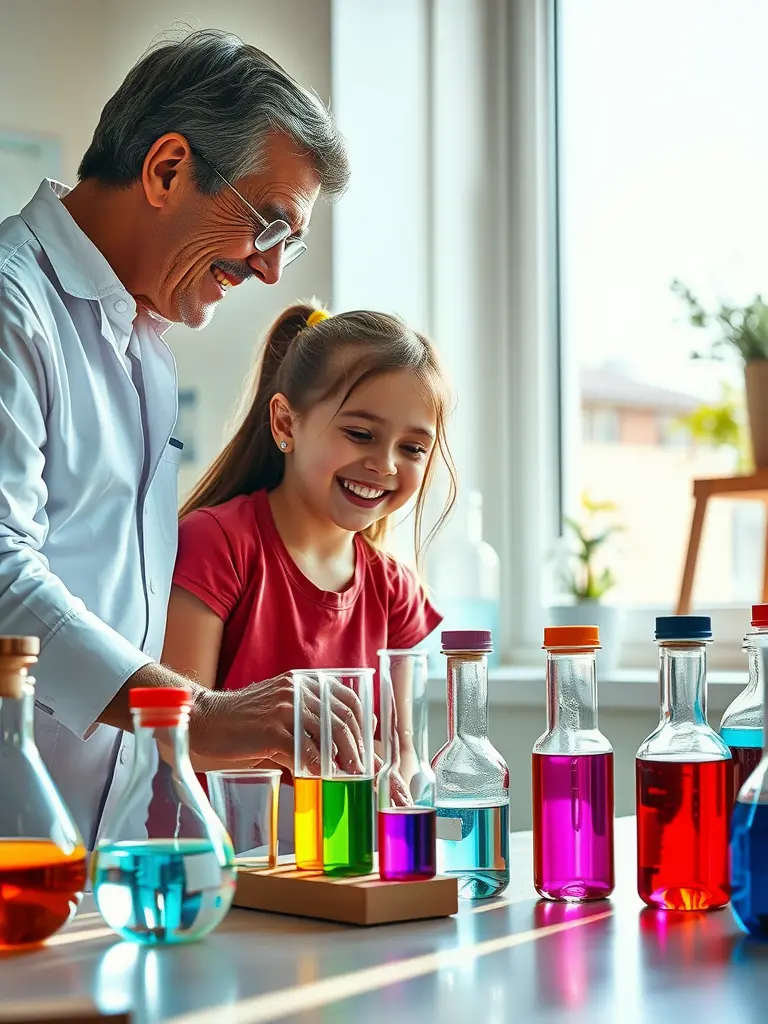
The sunlight streamed through the laboratory windows, casting golden rays that flickered on the tidy desktop, reflecting a variety of colorful test tubes and chemical bottles. Here, a family activity filled with laughter and learning was taking place. A young parent was with their child and a friendly elder, conducting an experiment related to the method of enhancement in this vibrant environment.
This laboratory was not only a hall of scientific research but also a place where knowledge and curiosity intertwined. The child's eyes sparkled between the test tubes, seemingly full of infinite anticipation for every chemical reaction. To help the children understand the core of the experiment, the elder patiently explained the basic principles of the enhancement method. This approach enhances the effectiveness of a particular substance and is widely used in science and life, becoming a new trend in education today.
"Do you know? The enhancement method is like adding a booster to this reaction!" the elder said in a relaxed and cheerful tone, pointing at a group of test tubes on the table. Every time he mentioned a little secret of science, the child's laughter would ring out, as if every small success in this space filled with the scent of chemicals was a celebration of victory.
The elder picked up a red test tube filled with a certain liquid and carefully poured it into another transparent test tube. At the moment the liquids mingled, dazzling colors began to change, and bubbles gradually appeared. The child's gaze was as intense as a flame, eagerly asking, "What reaction is this?"
"This is the magic of the enhancement method!" the elder replied with a smile, using this opportunity to guide the child to explore deeper knowledge. "Through the interaction of different substances, we can create unexpected effects!"
The atmosphere in the laboratory became increasingly lively, with children constantly requesting new attempts, and the elder generously sharing his experiences and adding vivid stories to every step. The parent watched silently from the side, feeling proud of the child's thirst for knowledge; this was not just a simple experiment but a legacy of familial love and wisdom.
In the next experiment, the elder demonstrated how to perform a neutralization reaction using acids and bases of different concentrations. He gently added a drop of acid to the base, and when there was a noticeable change in the liquid in the test tube, the children's gasps filled the space instantly. The elder smiled, watching their reactions, which reflected the true charm of science education—exploration and wonder.
"Let's add some colorants and see what interesting changes happen!" the elder said, and the children excitedly began adding various colored liquids to the test tubes. Every drop added was an adventure, as countless colors intertwined and collided in the test tubes, forming a unique whirlpool, as if it were a spectacular performance of chemical magic.
As the experiment progressed, the children gradually realized that the enhancement method was not just a scientific approach but a form of wisdom for living. The elder seized this opportunity to guide the children in thought, explaining how this method could be applied in the real world, such as in growth promoters for agriculture or enhancing the effects of medicines. They were not merely manipulating test tubes but painting vivid scientific images in their minds.
As the experiment neared its end, the elder remarked, "Science requires a lot of experiments to explore, just like every attempt in life. We can never predict the results, but as long as you are willing to explore, every reaction is worthwhile." The children listened attentively, gradually understanding the meaning behind his words.
On this sunny afternoon, the laughter echoing in the laboratory melted away the adults' fatigue and allowed the children's interest in science to flow like a spring. The elder's careful guidance not only taught the children the principles of the enhancement method but also how to observe and think about problems. For the parent, witnessing their child's smile and thirst for knowledge during the experiment was the most precious reward of this parent-child activity.
As the sun began to set, the experiment was drawing to a close, yet the children's curiosity remained fervent and unyielding. This was not just an experiment but a lesson in life that allowed children, accompanied by their parents and the elder, to experience the endless charm of knowledge and the joy of exploring the world. In this laboratory filled with chemicals, laughter and learning intertwined, and perhaps the future scientists were born among these delightful children.