
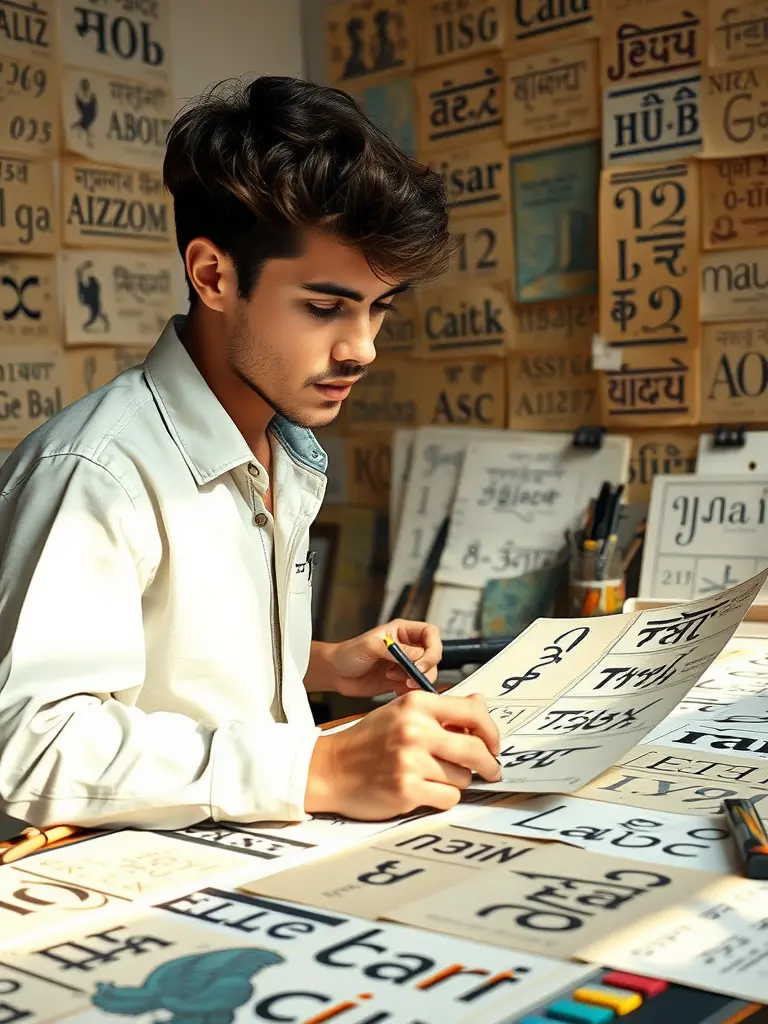
In this studio filled with creativity and inspiration, a painter is secretly conducting her experiments. The four walls of the studio are adorned with various font samples, making one feel as if they are in a feast of typography. These fonts vary in shape, from the traditional Regular Script and Clerical Script to modern Rounded Script and Running Script, each telling its own unique story and cultural heritage. Natural light streams through the windows, casting a golden halo over these calligraphic works, further highlighting the contrast and details among the fonts.
On the desk, a pile of the artist's works reveals that these pieces are not merely rehearsals of calligraphy but also a profound exploration of the beauty of language. The painter is diligently comparing the practicality of different languages' calligraphy. She clearly realizes that calligraphy not only represents culture but also carries emotions. To her, written words are not just tools for communication; they are windows to express the depths of the soul.
She initially chooses Chinese calligraphy as the starting point for her research, carefully analyzing the weight and rhythm of each stroke, and the aesthetic structure of each character. Then, she turns her attention to other languages, such as Arabic and Russian. These seemingly disparate writing systems possess a common beauty in her eyes. In Arabic calligraphy, smooth curves merge with geometric shapes, creating a unique visual appeal; while the Russian writing style is more robust, embodying a sense of mechanical elegance.
Throughout this repeated experimentation, the painter continuously adheres various calligraphic styles to the walls of the studio. As she observes these works from different angles, waves of creative inspiration flood her mind like a gently flowing stream. Each language tells her a different cultural story, and each stroke seems to guide her in her creative direction.
Interestingly, the painter's creative process is not limited to traditional calligraphy techniques; simultaneously, she experiments with incorporating different elements into her calligraphy. She uses paint to decorate the characters, making them shine like stars, or combines them with the landscapes of the southern regions to create stunning works. In her eyes, these words are no longer mere text; they are part of life, carriers of her thoughts and emotions.
As her research deepens, she begins to explore the practicality of calligraphy and how to integrate this traditional art into modern society. She realizes that with the advancement of digital technology, many people have moved away from the tradition of handwriting, opting instead for the speed and convenience of typing. However, she firmly believes that calligraphy will not be forgotten; rather, it should become a more precious art form. Her works aim to bring the beauty of calligraphy back into people's view, allowing everyone to feel the emotional connection flowing from the tips of the brush.
In the tranquil studio, accompanied by the sound of brushes against paper, time seems to stand still. The painter's focused gaze exudes a sense of determination and devotion. She hopes that through her efforts, people can rediscover calligraphy, understanding that it is not just writing but an expression of emotions, a manifestation of art. In her heart, each character in calligraphy is an independent life, individual yet complete, radiating its unique brilliance no matter where it is placed.
In this atmosphere, her research is not just about creation, but also a spiritual cleansing. She begins to contemplate how to make these works more relevant to daily life, how to make calligraphy a part of everyday experience. Thus, she designs a series of workshops, inviting community members to participate. In these workshops, she teaches the basic techniques of calligraphy, shares the historical background and cultural significance of various scripts, and encourages each participant to discover their own creativity.
When the workshops commence, the studio is filled with an atmosphere of anticipation, with participants' eyes sparkling with excitement and curiosity. Young students, older calligraphy enthusiasts, and art-loving friends all eager to immerse themselves in the charm of this traditional art form. The painter patiently guides each participant, her demonstrations and explanations seemingly opening a door to a new world for them.
As time passes, the sound of calligraphy practicing resonates in the studio. In the immersive atmosphere, everyone interacts and shares their creations. What they depict in their brushwork is not only the beauty of the fonts but also the resonance of their souls. The continuous stream of creative inspiration turns the studio into a cultural crossroads, making calligraphy not just art but also a bridge for people to connect emotionally.
The painter's efforts do not stop here. With the successful hosting of her workshops, she begins to plan online courses to broaden the scope of learning about calligraphy. Therefore, she utilizes digital technology, recording courses and sharing them on platforms, allowing more people to enjoy the atmosphere of calligraphy from home. This series of actions not only expands the charm of calligraphy to a wider space but also breathes new life into this ancient art in modern society.
As the influence of the workshops grows, her works start to attract attention, even becoming important content in exhibitions. Every time her works are displayed, the studio retains its tranquil and focused atmosphere, drawing in audience members who appreciate calligraphy. Each piece seems to tell a story, conveying the continuation of culture and the resonance of emotions.
Through the painter’s exploration, calligraphy gradually transforms from an obscure skill into a part of life, becoming a means for people to seek inner peace. Her studio, along with the spreading of this art, transforms into a fertile ground for creation and exchange. In the face of such change, the painter feels grateful, knowing that her efforts have ultimately been worthwhile; in this busy and hurried era, the power of art enables people to rediscover themselves.
Ultimately, the painter's studio becomes more than just a place for creation; it evolves into a center for cultural exchange, allowing the beauty of calligraphy to continue to shine. The focus and passion she upholds in her work reflect in the flowing letters, bearing witness to her love for life and her infinite pursuit of calligraphy. She firmly believes that calligraphy is not just the pen in hand, but the emotions in the heart; it is a common stage for every creator. Thus, the journey of a painter mirrors the shared experiences of countless artists in their pursuit and persistence; this pursuit of beauty, regardless of time and space, will never fade away.