
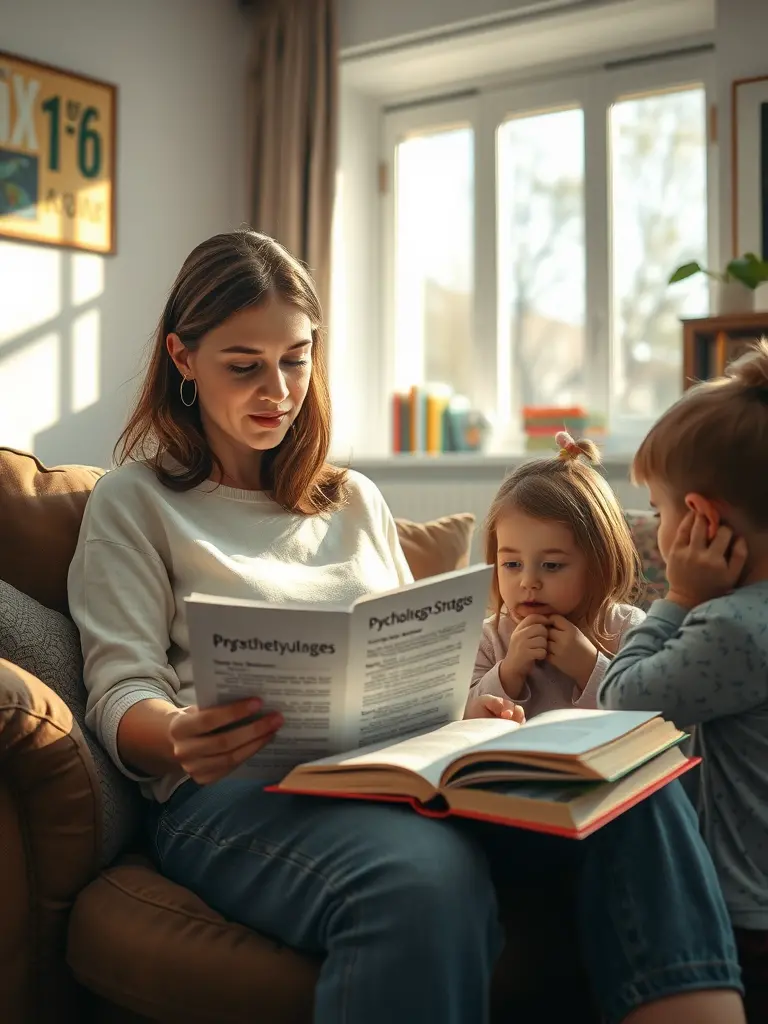
The sunlight streams through the gaps in the curtains, illuminating the cozy living room, where a faint aroma fills the air, creating a sense of comfort and relaxation. However, in this warm scene, a mother sitting on the sofa shows a serious expression as she flips through a thick psychology guidebook, as if this book is the treasure she seeks for comfort and wisdom.
On the other side of the living room, two children exhibit carefree innocence, their playful laughter filling the space. Little blocks are scattered on the floor, where their creativity and imagination run wild in this small realm. The older daughter is focused on building a tall tower, while the young boy frequently gasps in amazement and excitement at his sister's creation. This innocent scene contrasts sharply with the mother's concentration on seeking answers in her book, provoking deep reflection on the current challenges of parenting.
In the mother's heart lies a mix of unknowns and anxieties about the future. She is striving to find new ways to help her cope with the various mental health issues her children might face. Especially in the current social context, many experts emphasize that emotional management and psychological education are crucial to children’s growth. It's not just about academic achievement, but also about the richness and stability of their inner world—a consensus among all parents in the upbringing process.
Immersed in the book's content, she can feel the analysis of every psychologist regarding the deep-rooted reasons behind children's behavior. The words on the pages act like a window, allowing her to glimpse into her children's inner world. She can't help but ponder what strategies can better support her children's growth and inject positive psychological nourishment into their lives. For instance, how can she use gamification to enhance her children's emotional intelligence? Or how can daily communication promote their self-expression skills?
At this moment, the mother’s gaze is inadvertently drawn to the sunlight outside, as if the light is not only warm but also brings a glimmer of hope. The suggestions in the book begin to echo in her mind, about how to establish a good parent-child relationship, how to understand and respond to her children's emotional needs, and how to cultivate their problem-solving abilities.
The children, sitting nearby, cannot fully grasp the struggles within their mother, but their innocent laughter seems to become her greatest comfort. One child’s innocent question, "Mom, can I help you?" instantly melts the anxiety in the mother’s heart, as if reminding her that parenting is a journey of mutual support, not just one-sided giving. It makes her realize that perhaps, in this process, the children can also be her supporters, growing together.
At this moment, the living room becomes more than just a space in their home; it is a microcosm filled with opportunities and challenges. In this small society, communication and understanding are paramount. The mother gradually understands that communication is not just verbal exchange but also the blending of emotions and the touching of souls. She begins to record her children's emotional changes, each instance of play, every quarrel, and even each unintentional eye contact becomes valuable experiences for her future parenting.
For her, this psychology guidebook transforms from a mere accumulation of theories into a practical tool for enhancing the mother-child relationship and understanding her children's psychological states. She consciously integrates the book’s suggestions into daily life, evolving from merely learning from the book to actively implementing these strategies. Through setting up parent-child activity times and regular emotional sharing, she strives to create a more open and safe family atmosphere.
This transformation is not solely confined to the mother’s efforts, as the children's responses also bring her great joy. The young boy shares during one activity that he wishes for more parent-child interactions and looks forward to participating in various fun activities. Such wishes convey encouragement, allowing her to see her children's desires and growth.
As time passes, the mother discovers that her relationship with her children is quietly changing. The parenting journey, once filled with anxiety and doubt, begins to show glimmers of hope and light. Whether it’s the children’s achievements at school or the joy they find in play, all serve as the best testament to the mother’s efforts. She begins to comprehend that parenting is not a solitary struggle but a shared journey of growth.
The book brings her not just knowledge, but also a sense of confidence—a courage to face future challenges. The mother quietly reflects that perhaps, in this uncertain process, the most important thing is not to seek perfect answers but to maintain an open mindset, allowing each exchange with her children to be meaningful and valuable.
The sunlight continues to pour into the living room, enveloping this small space in golden rays. The mother no longer feels alone; she understands that no matter what challenges lie ahead, the most important thing is always mutual understanding and support. As she gently closes the book, a profound sense of gratitude overflows in her heart, making her realize that it is all worth it. Each thought, every lesson learned, adds a profound layer of meaning to this parent-child journey, illuminating the path ahead.