
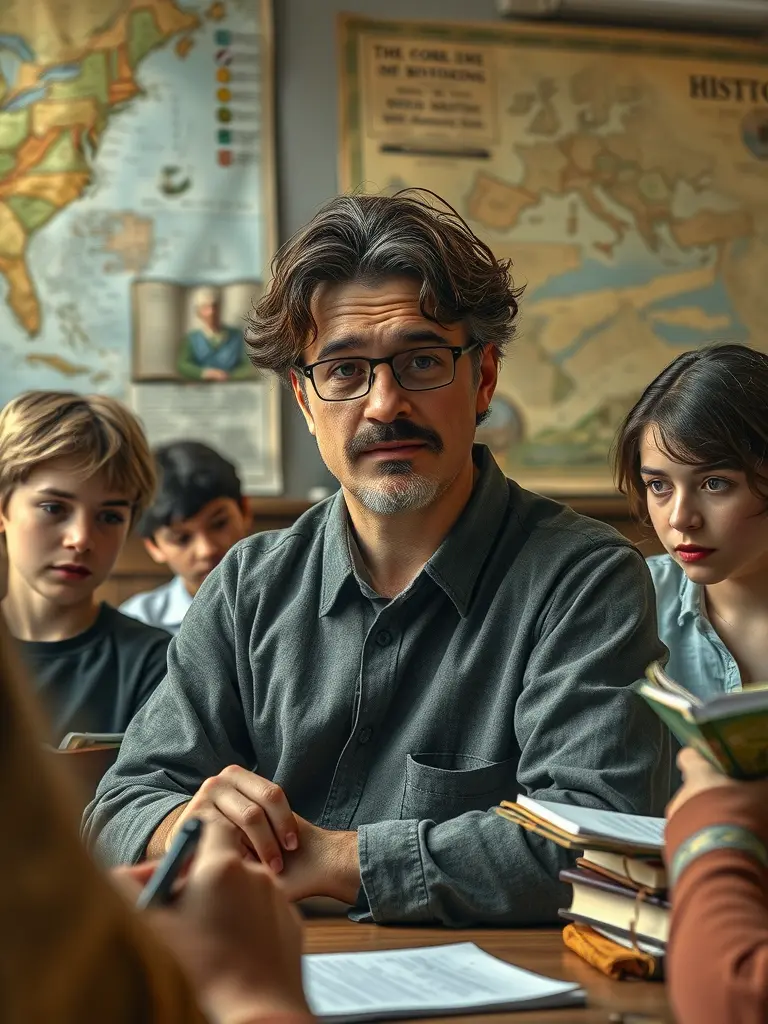
A history teacher recently conducted a unique lesson in class that connected age-old wisdom with themes closely related to modern life, capturing the attention of all the students. While teaching ancient history, he skillfully employed positive reinforcement techniques to教導學生 how to effectively lose weight, successfully creating a learning environment that intertwined the ancient and the modern.
In the classroom, ancient books and maps surrounded the students, resembling a window into the past. The walls were adorned with maps depicting ancient civilizations, marking the dietary cultures of ancient Egypt, Greece, and Rome, and how they influenced later eating habits. The teacher focused not only on the textbook content but also utilized this historical context to take students on a culinary and cultural exploration journey.
The students listened attentively, their notebooks filled with dense writing, showing their interest and focus. The history teacher introduced various effective weight-loss methods, drawing on the wisdom of food therapy found in folklore, mythology, and ancient medical texts. He mentioned that many ancient cultures advocated for moderation in diet, emphasizing the phrase "food for health," which was particularly evident in the dietary habits of the past. For instance, ancient Greek physician Hippocrates famously stated, "Food is medicine," a concept that remains valuable today.
The teacher also emphasized the importance of dietary habits and lifestyle in weight loss, mentioning various positive reinforcement techniques, including controlling portion sizes for each meal, increasing fiber intake, and maintaining good hydration. He used discussions from ancient medical texts to teach students how to achieve weight loss goals through a balanced diet combined with sufficient exercise. Throughout this process, he effectively merged ancient wisdom with modern scientific knowledge, allowing students to learn the correct methods of weight loss in a relaxed atmosphere.
During class, students began discussing their own lifestyles and eating habits, with some classmates sharing their dietary plans and exercise experiences under the teacher’s guidance. Through such interactions, the students not only gained a deeper understanding of weight loss knowledge but also enhanced their communication and friendship with one another. This lively learning method illustrated how the teacher successfully utilized positive reinforcement techniques, enabling students to naturally absorb knowledge through participation.
The unique aspect of this lesson was that students were not just learning methods for weight loss; they were exploring how to reflect on contemporary lifestyles through history. As they embarked on their dietary plans, they discovered that the dietary philosophies of many ancient cultures resonated closely with modern dietary concepts. In this process, the students’ thinking broadened, inspired by ancient wisdom, leading to a profound interest in history.
As the class progressed, the teacher began to guide students in exploring how ancient dietary habits influenced the modern society's weight loss culture. He asked, "Can we draw inspiration from ancient dietary philosophies to make today's lives healthier?" Students eagerly raised their hands to share their views, creating a lively and energetic atmosphere. Some mentioned the luxury and health contradictions of ancient nobility, while others pointed out that the simple diets of farmers were more beneficial for health. Such dialogue not only enriched the class content but also promoted students' reflection on history.
In the climactic part of the lesson, the teacher organized a small experiment. Each student prepared a simple healthy recipe and then showcased it in class. During the presentations, they not only shared their recipes but also introduced the historical stories and cultural significance behind them. Each recipe was an interpretation of healthy eating concepts, demonstrating how to apply ancient wisdom to improve their health in everyday life.
Through this engaging approach, students learned how to view diet and weight loss correctly through interaction and internalized this knowledge into their behaviors. As the class atmosphere reached its peak, students began reflecting on their eating habits, further igniting their interest and enthusiasm for the next steps.
At the end of the class, the teacher reiterated that weight loss is not an instant process but requires sustained effort. He encouraged students to closely integrate what they learned today with their daily lives, forming their own healthy eating plans. Students left the classroom with a wealth of knowledge and inspiration, filled with unprecedented anticipation and confidence.
This lesson was not only a transmission of historical knowledge but also a deep reflection on modern health concepts. By listening to the echoes of history, students found a source of wisdom in what seemed to be a simple topic of weight loss. Ancient wisdom reiterated its importance here, helping students understand the true meaning of weight loss: choosing a healthy lifestyle and cherishing the quality time shared with family and friends. As the ancient saying goes, "We are what we eat, and that determines how we live."