
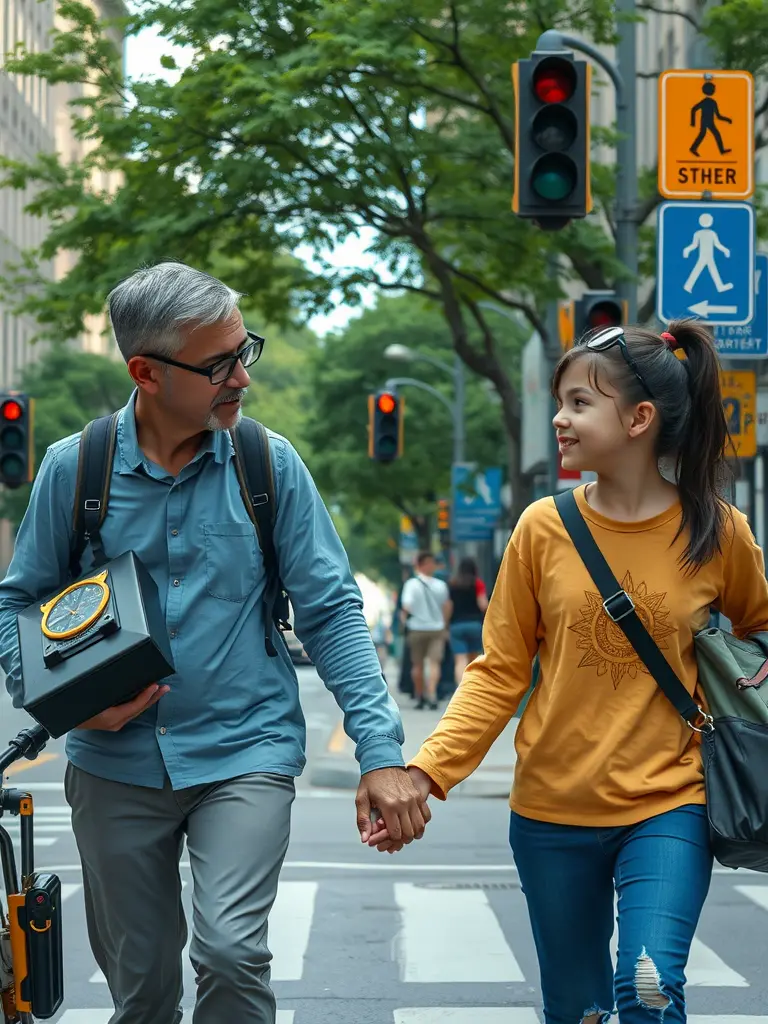
On the busy city streets, the incessant noise of passing vehicles and the bustling crowds seem endless. In such an environment, a working parent is holding their child's small hand, their gaze focused on the white safety pedestrian sign ahead, filled with care and expectations for safety. The surrounding green trees sway gracefully, as if bringing a breath of fresh air and a peaceful atmosphere to them amid the challenges of urban life, allowing them to feel the little beauties of life even in their busy daily routine.
As they cross the crowded street, the pace of the parents and child is slow yet steady, their eyes communicating a gentle affection. With the change of the traffic light, the parents carefully observe the passing vehicles and say softly to their child, "We can only cross when the light is green." This statement is not only a warning but reflects their emphasis on the child's safety and education. The child nods earnestly, their eyes sparkling with curiosity, as if they are fascinated by this world that is still somewhat unfamiliar to them.
This scene inevitably reminds one of the importance of pedestrian safety signs. Amid the speed of vehicles and the busyness of city life, these facilities serve as an indispensable safety line between parents and children. The bright colors and simple shapes of pedestrian signs are like every reminder and lesson parents impart to their children along the way. These simple yet effective designs undoubtedly add a significant sense of safety to urban living.
On one side of the busy street, the trees lining the sidewalk seem to be nature's shelter for the city, providing pedestrians with a refuge. The shadows cast by the trees create dappled patterns on the ground, vibrant yet serene. As the parents and child stroll here, they are not only navigating through the city's chaos but also seeking a balance and tranquility in life. With the gentle breeze rustling the leaves, it seems to whisper: walk carefully, safety comes first.
At this moment, the traffic light flashes green, and the parents extend their hands, gently holding onto their child's hand, taking steps toward the other side of the road. The vehicles at the intersection reluctantly pass by, no longer posing a threat to them. In such a moment, everyone enjoys not only the safety brought by the traffic light but also the precious time spent together as a family. The child looks up at the parents and, somewhat nervously yet curiously, asks, "Why do we have to wait for the green light?" The parents smile and reply, "Because that ensures we can cross the street safely, understand?"
For the child, this is a vivid lesson in traffic safety. The parents use the simplest language to convey what safety is and what responsibility entails. In this fast-paced life, having such a moment, where parents and children learn from each other and grow together, is something every family should cherish.
This scene is not limited to a single family or moment, but represents the daily life of countless families. In the bustling metropolis, parents experience each day like riding a carousel, enjoying the balance between work and life. They wrestle within, constantly missing the time spent with their children, hoping to carve out some moments to grow with them amid work.
The efforts and sacrifices of parents do not go in vain; children learn to discern safety from danger under their care, and their problem-solving abilities increasingly enhance. In every late-night light, parents read manuals on safety and traffic, tirelessly imparting knowledge to their children. They deeply understand that every detail of education lays the groundwork for their child's future, both in terms of knowledge transmission and life protection.
Thus, the establishment of safety pedestrian signs becomes especially vital—reminding drivers while protecting pedestrians. Experts point out that urban safety facilities must consider the needs of pedestrians while also accommodating the visibility and driving experience of drivers. Societal progress is not only reflected in the towering buildings but also in every minute detail, allowing lifestyle and urban infrastructure to integrate and support each other.
In this atmosphere, traffic safety education programs initiated by municipal departments gradually begin to unfold, aiming to raise public awareness of safety and prevention. Through a series of practical drills and interactive teaching, children learn traffic rules through play, and parents partake together in cultivating good traffic behaviors and habits, instilling safety into the hearts of every family.
As time goes by, this scene repeats on every street in the city, with parents and children tightly holding hands as the safety pedestrian signs leave a beautiful landscape in their hearts. Meanwhile, these small moments become the warmest chapters of each city's story, attesting to the city's development and family care. The busy street undoubtedly becomes a canvas of life, where each pair of parents and children is an indispensable hue in this painting.
Through careful observation, every choice and call encapsulates the future mission of the city. As parents teach their children to cross the street, they are also shaping the child's understanding of interpersonal relationships, nurturing a deeper sense of social responsibility and inquiry in future generations. Each safe step harmonizes the rhythm of the city, awakening a long-lost resonance among the crowds.
In every corner of the city, countless ordinary yet meaningful stories are unfolding. They convey not only traffic safety information but also plant valuable life wisdom for children. Every time parents hold their child's hand while crossing the safe pedestrian path, they not only guide their child but also seek their own spiritual sanctuary. In the urban jungle, the softness within parents' hearts is like the quietly blooming greenery—forever stunning, and eternally vibrant.