
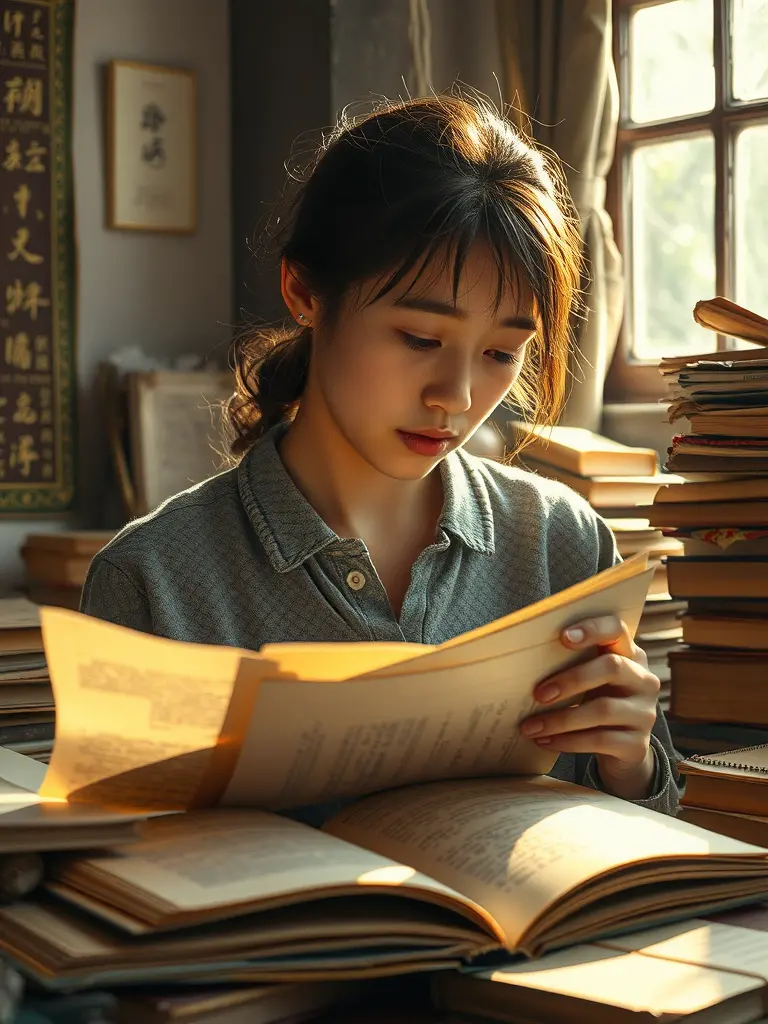
On a quiet afternoon, a mother sat quietly in her study, surrounded by the unique scent of ancient books in the air. Over time, this study seemed to gradually transform into her sanctuary, allowing her to immerse herself in the connections between the past and the present. Sunlight streamed through the window, casting a gentle glow on her focused face, as if providing a sacred shelter for her soul's journey.
She flipped through precious historical documents, the yellowing papers and books bearing witness to unforgettable stories. These documents were not merely a collection of words but containers of time, carrying the joys and sorrows of people from the past. Her fingertips lightly brushed over the text, as if she were touching the pulse of history, feeling the vibrant souls within.
The arrangements in the study reflected her taste and profound cultural background. On the old bookshelf, books were neatly lined up, some adorned with ornate golden lettering, others telling their stories with simple yet elegant designs. These books were not only a source of her wisdom but also indispensable companions in her life. She understood that the shadows and light on these faces were reflections of memories from the past in the present moment.
As she slowly turned the pages, the history she once knew began to come alive. She saw how events that occurred at different times shaped the current social landscape and how they affected those living in suffering and joy. A strong desire grew within her to share these stories with her children, not only to help them understand the flow of history but to make them aware of the brilliance and shadows inherent in human nature.
The sunlight’s patterns shifted, and she felt an incredible peace. This quiet exploration allowed her soul to dance with the memories of the past. She could sense the wisdom, courage, and creativity of her ancestors; these experiences nourished her spirit, providing her with confidence and inspiration in raising her children.
When she came across certain special pages, her heart would resonate profoundly. The events described in the words continually sparked her thoughts. She pondered how to maintain the continuity of history in today’s rapidly changing world, helping her children appreciate the wisdom of the past and apply it in their future lives. She knew she must play the role of a guide, helping her children find direction in life through the gaps in history.
Throughout this process, various thoughts began to intertwine in her mind. The stories of history seemed not merely to be a dusty past but also a precursor to the future. She organized the rich historical materials, attempting to transform them into easily understandable language for her children. She wanted to make these stories vivid, allowing her children to feel the pulse of the past as they read and think about the future.
In that moment, she realized that education was never merely about imparting knowledge; it was about helping learners find their place within that knowledge. She tried to incorporate the history she had learned into her family education, striving to plant seeds of thought in the lives of her children. She hoped they could develop an understanding of the world and a sense of identity through these vivid historical stories.
As time progressed, the mother gradually became her children’s most trusted learning companion, and reading time transformed into a shared experience. She would use her weekends to sit in the study with her children, sharing those precious historical documents. Sometimes, she prepared little games to make understanding complex historical facts more engaging. While telling stories, she guided her children to think, hoping to nurture their cognitive and critical thinking skills so that they would possess strong personal qualities as they grew.
During that period, her children’s eyes sparkled with a thirst for knowledge, and the mother felt compelled to continually explore new areas alongside this yearning. She discovered that the path of education was not always smooth; sometimes, it was filled with challenges and setbacks. One day, the children questioned certain historical events, prompting deep reflection from the mother. She realized that instead of providing answers, why not involve the children in the exploration process, guiding them on how to find the answers themselves.
Thus, the mother began to guide her children in deeper research, together flipping through those ancient documents and files. This interactive learning environment created a more harmonious family atmosphere and subtly built the children’s interest in history. Under her guidance, the children gradually learned how to ask questions, how to think from multiple perspectives, and even began to look up and explore historical topics of interest to them. These experiences not only enriched their knowledge but also honed their analytical skills.
These interactions became an indispensable part of family life; in the book-filled study, the mother and her three children always found joy. At that moment, as sunlight poured through the window, history took root and blossomed in their hearts, becoming one of the most beautiful memories of their lives. Whenever the mother saw her children's joyful smiles, she felt that all her efforts were worth it, for she understood that she was passing down precious historical stories to the next generation.
This interaction also inspired the mother to write her own historical short stories. She began to document their experiences and exploration process, hoping to inspire more families. Within her writing, she intertwined her deep thoughts on history with the joy of reading together with her children, presenting vivid images for future young readers eager to learn about history.
Outside the study, the seasons shifted with the blooming spring flowers and autumn moons, and those precious historical documents seemed to continue to ferment with her thoughts, becoming an indispensable source of inspiration in her life. The mother’s historical journey was not merely an accumulation of knowledge but an understanding and exploration of life. In that restless era, she used her efforts to make history concrete and lively in daily life, knowing that only by genuinely confronting history could hope and wisdom be passed on to future generations. On this long educational journey, the interactions and explorations between mother and child not only represented the continuity of history but also the transmission of culture, as well as the precious memories of the shared growth of every family member.