
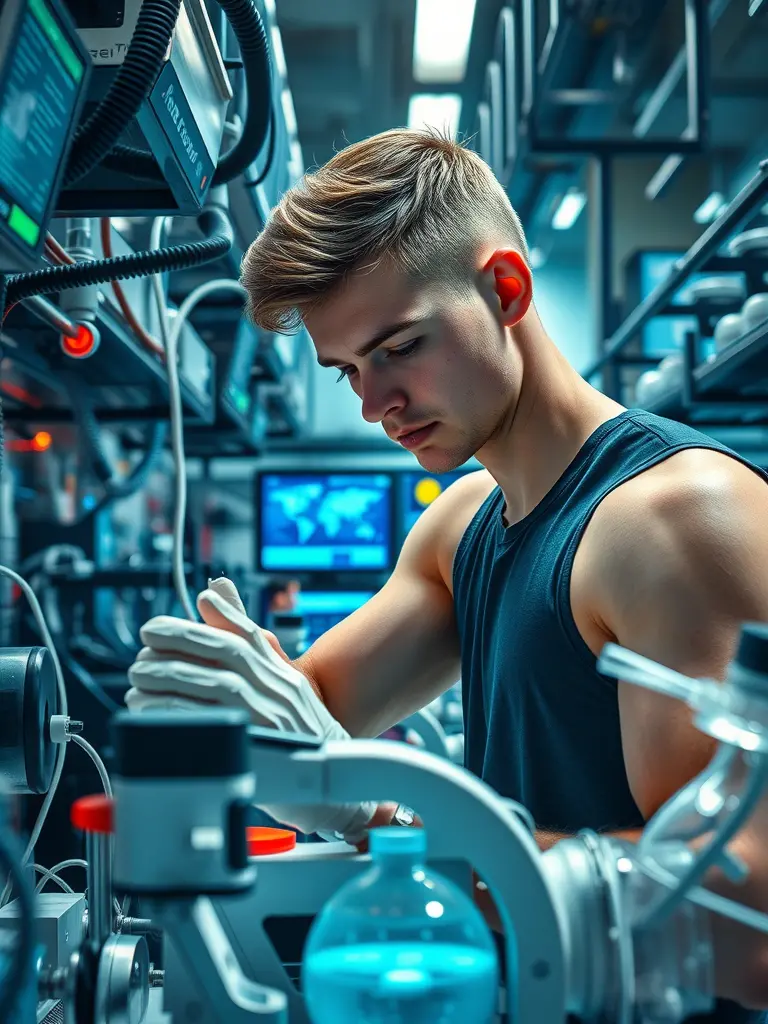
In today's competitive and challenging era, fitness has become not just a lifestyle, but a new trend that combines technology with health. Recently, a fitness enthusiast dressed in sportswear conducted an unprecedented sports science experiment in a high-tech laboratory. This experiment not only highlighted the value of individual effort but also prompted us to reconsider how technology can redefine the future of fitness and health management.
The laboratory is located within a modern building, surrounded by various advanced technological equipment, creating a strong sense of futurism as one enters. Transparent glass walls display various biometric data, including the fitness enthusiast's heart rate, calorie consumption, oxygen intake, and other key indicators. These data continuously flicker on large digital display screens, reminiscent of a scene from a science fiction movie.
The fitness enthusiast, named Xiao Yang, performs each movement in the laboratory with meticulous design. His sportswear is embedded with micro-sensors that continuously collect data on his heartbeat, muscle tension, and exercise efficiency. These data are transmitted in real-time through high-tech devices and analyzed by a professional team. Xiao Yang focuses intently on the screen, observing the changes in exercise data and his physical condition with every squat and push-up.
The environment of the laboratory resembles a high-tech gym, equipped with the latest smart fitness equipment. These devices not only adjust exercise intensity but also provide optimal workout recommendations based on the user's real-time data. Xiao Yang utilizes this equipment to perform various exercises, constantly adjusting his training plan to achieve the best performance.
Behind this experiment is the collaborative effort of a team of technology and sports experts. Their goal is to integrate data science into fitness, allowing every fitness enthusiast to make scientific exercise decisions based on their own data, thus enhancing workout effectiveness. The leader of the research team stated that the development of this technology signifies that personalized fitness will become possible, transforming traditional workout methods and enabling individuals to tailor and adjust their fitness plans according to their needs.
Throughout Xiao Yang's experiment, the research team continually inquired about his feelings and physical condition to further refine the system's design. This process allowed Xiao Yang to experience the perfect combination of technology and fitness. He gained a clearer understanding of the changes in his body and achieved higher training effects guided by data. This deep integration not only assists in exercise but also provides every fitness enthusiast with a shortcut towards their ideal physique.
During the experiment, Xiao Yang also exhibited a strong curiosity towards new technologies, frequently asking about the underlying principles and various data analysis methods, which further motivated the research team. After several hours, the experiment concluded, and the data analysis revealed significant improvements across various indicators, including heart rate, muscle endurance, and even calorie consumption, all of which met his expected goals.
Xiao Yang's success was not a coincidence. This series of experiments required individual effort and the support of high-tech equipment. The molecular biology technology in the laboratory allowed researchers to analyze the reactions of muscles and cells during exercise in greater depth. These studies not only help athletes enhance their performance but also provide more scientific guidance for regular fitness enthusiasts in their daily training.
The most exciting aspect of the entire experiment was the interaction between the fitness enthusiast and technology. After completing each set of exercises, the system provided immediate feedback, which represented not only changes in data but also allowed him to feel the thrill of self-challenge at all times. When he saw clear upward trends in his data, that sense of achievement further solidified his dedication to fitness.
Through this experiment, we witnessed the seamless integration of technology and health. The future of fitness will no longer be merely physical labor; it will be a comprehensive experience that combines data analysis, intelligent guidance, and behavioral science. As data continues to accumulate, this smart fitness system will keep improving, ultimately maximizing the potential fitness results for its users.
This research is not only exploring new models of fitness but also represents a part of humanity's future lifestyle. In the future, we may see more collaboration between humans and technology, allowing every fitness enthusiast to become a data scientist of their own body, using the power of technology to take control of their health.
As Xiao Yang left the laboratory, he wore a satisfied smile, filled with anticipation for his future fitness journey. He understood that this was not just a personal milestone, but a new beginning for many fitness enthusiasts. With the support of technology, every fitness enthusiast will embark on their own journey of progress, welcoming a healthier future.