
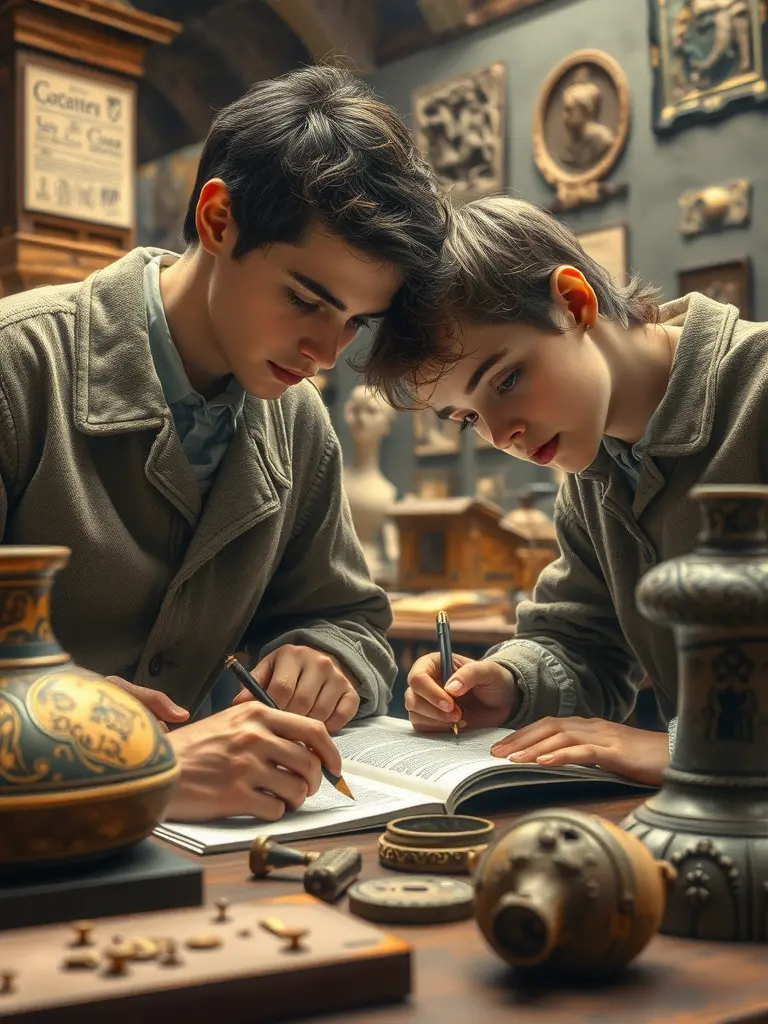
In a quiet corner of the museum, the footsteps of the historian are silent and unobtrusive. In front of a massive glass display case, he intently observes an ancient artifact, as if time itself has come to a standstill. This is an extraordinary moment, as the scholar engages in a profoundly meaningful study, attempting to decipher every detail of human history from the treasures of the past.
The dim yellow light gently illuminates his face, creating a picture of contemplation. In the silent space, the only sound is the soft rustle of his fingers flipping through notes on the table, contrasting sharply with the silent artifacts in the display case. Surrounding him are precious collections from different eras, each item emanating stories from the past, like a silent storyteller waiting to be uncovered by the discerning.
The research notes laid out on the table, filled with dense handwriting, showcase his passion and dedication to history. Within the text, one can glimpse the deep emotional connection he has with the artifacts, with his words reflecting a sense of awe for ancient wisdom and technology. Occasionally, the scholar lightly touches certain keywords in his notes, as if in contemplation or communicating with a wise figure from the past. This is a unique little secret; both in interpreting artifacts and reflecting on history, he starts with the details.
The subject of the historian's research is a piece of pottery from ancient times, which appears ordinary at first glance, but its intricate patterns contain rich cultural connotations. Upon closer observation, these patterns seem to come alive, almost narrating the lifestyles and emotional expressions of people from that era. His gaze is akin to that of an explorer, always finding new clues at every turn, navigating the sea of thought.
While the shape and color of the pottery may initially seem unremarkable, the scholar's sensitivity and attention to detail transform it into a vibrant entity. Through further analysis, he speculates that these patterns might represent symbols of social status; perhaps possessing such a piece of pottery in an ancient tribe brought unparalleled honor. He gazes at the pottery, as if engaging in a spiritual dialogue with the ancient artisans, sharing an understanding and reflection on the creative process.
The scholar's exploration does not stop there; he records hypotheses regarding the historical background in his notes and sketches simple diagrams for reference. By employing a multi-faceted observational approach combined with existing archaeological discoveries, he develops new academic perspectives. His research is not just about explaining the existence of this pottery, but also about uncovering the cultural significance behind it and how it has influenced future generations over the long passage of time.
On the other side of the museum lies a starkly contrasting scientific laboratory. Researchers are using high-tech instruments to analyze the chemical composition of various artifacts, providing new perspectives for the study of ancient items. The introduction of this technology undoubtedly opens up new possibilities for historical exploration, enabling scholars to gain deeper insights into the origins and characteristics of each artifact.
It is noteworthy that with the advancement of technology, traditional historical research methods are also undergoing transformation. Ancient artifacts are no longer just treasures in the eyes of archaeologists but are subjects of interdisciplinary collaboration. The interactions between historians and scientists are becoming more frequent, and such collaborations may reveal more historical truths in the future.
As the sky gradually darkens, the lights in the museum begin to glow, reflecting upon the scholar's face, his gaze unwavering, immersed in the joy of research. Each entry in his notes seems to add a new stroke of color to the long river of history. The scholar's dedication and passion are undoubtedly vital forces propelling historical research forward.
For a historian, such a night is a serene celebration. They wander among the artifacts, merging the ancient world with modern thought. They know they bear the responsibility of revealing the stories forgotten by time to the world. Perhaps many years from now, these research findings will shine like brilliant pearls in the starry sky of human civilization.
Thus, in the soft light, the scholar continues his journey of historical exploration, gradually incorporating these unique little secrets and profound cultural emotions into his notes. Each discovery he makes may become a thought-provoking thesis topic, further promoting academic exchange, and may one day spark greater historical discussions and attention.
This journey of exploration is not merely about the archaeological excavation of ancient artifacts, but also addresses the challenges and reflections experienced by human civilization and those it is yet to face. The historian in the museum, through each artifact’s story, is indeed writing the future of humanity, and the unique little secrets emanating from every detail will become the torch for future generations, guiding new explorations and discoveries.